Manufacturing complex geometries often forces engineering teams into a difficult trade-off. You can machine parts from solid billets, but that drives up material waste and limits internal features. Or you can fabricate assemblies, but that introduces weak points at every weld.
Metal casting solves these structural and geometric challenges by letting you create near-net-shape components. But for engineering managers and procurement leads, the challenge isn’t just understanding the physics of molten metal, but also dealing with factors like tooling costs, lead times, and quality control.
In this article, we’ll break down everything you need to know about metal casting, including what metal casting is, why and when you should use it, and the various types of metal casting available.
Table of Contents
Key Takeaways
- Metal casting has been around for millenia and is often used for creating complex internal cavities and external geometries.
- From ferrous alloys for structural strength to non-ferrous aluminum for lightweight applications, casting handles a much wider range of materials than forging.
- Sand casting offers low tooling costs for low volumes, while die casting requires high upfront investment but delivers the lowest per-unit cost at scale.
What is Metal Casting?
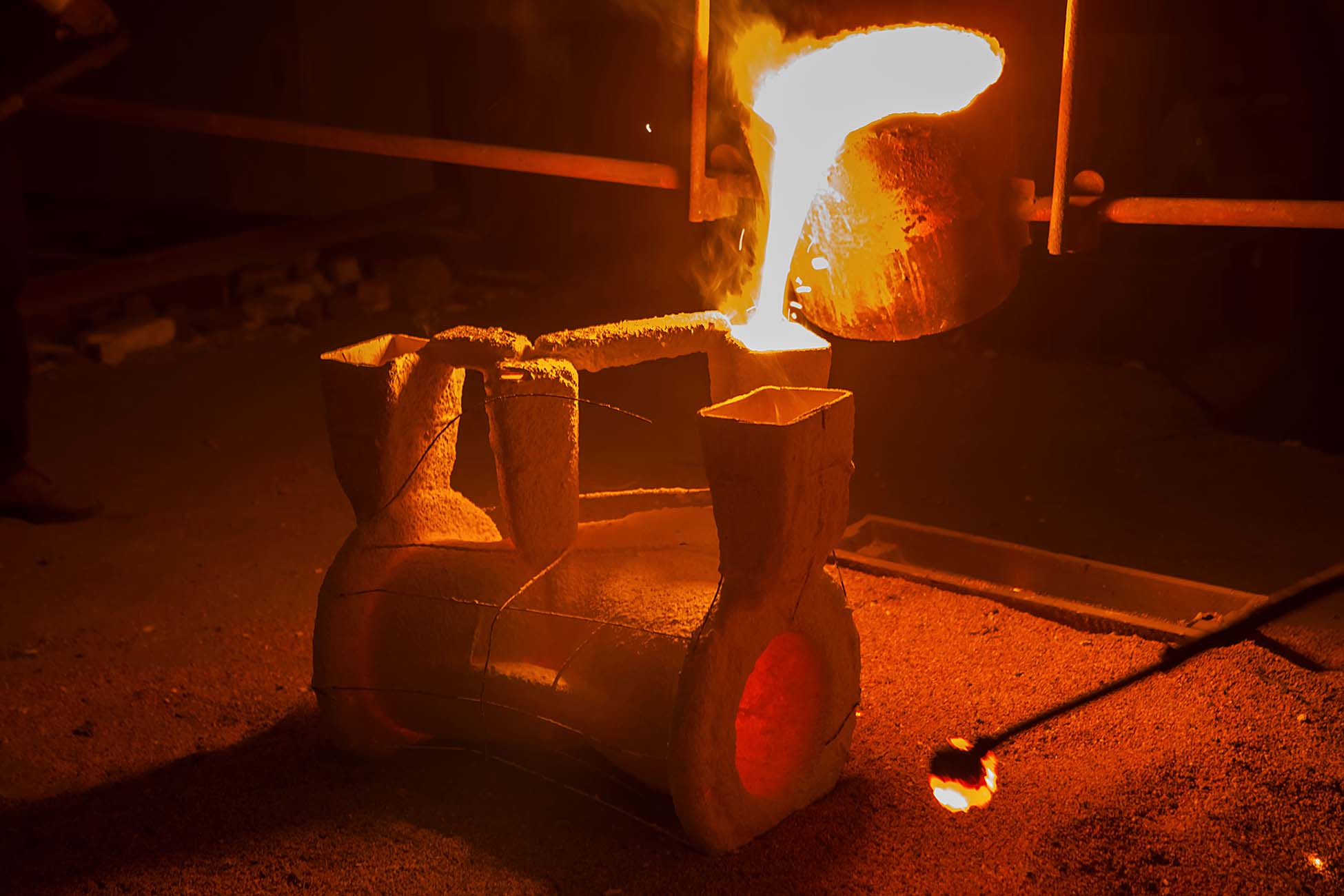
Metal casting is a manufacturing process where molten metal is poured into a mold containing a hollow cavity of the desired shape, allowed to solidify, and then removed. The solidified part, known as a casting, is then ejected or broken out of the mold to complete the process.
For the past 6,000 years, metal casting has been used to manufacture everything from swords and wedding bands to sprockets and screws. Today, this technique is essential for producing complex metal parts that would be otherwise difficult or uneconomical to make by other methods.
Why Choose Metal Casting?
Throughout its history, metal casting has been used to create components that would be too difficult or costly to manufacture by forging. By using metal casting, you are able to accurately and effectively manufacture large numbers of identical metal parts.
Because every metal casting is made using a custom pattern and mold, metal casting is also ideal for manufacturing both small and large items. Additionally, since metal casting involves melting down pieces of metal, this process allows metal scraps to be recycled and reused, therefore reducing waste.
The 4-Step Metal Casting Process Explained
Since the process involves a custom mold, metal casting can be used to create metal objects with a large variety of shapes and sizes. But while the specific techniques vary between methods, the fundamental physics remain consistent. Let’s take a look at how each metal casting comes to life.
Step 1: Patternmaking
Every casting starts with a pattern, which is a model of the final part that will be made. For sand casting, this might be made of wood or plastic. For investment casting, it’s typically wax. The quality of your final part depends entirely on the accuracy of this pattern.
Step 2: Molding
Next, a mold is designed and made using the pattern. Molds can be reusable, meaning they are used repeatedly to cast identical parts, or expendable, meaning they are used only once and destroyed in the casting process.
Step 3: Melting and Pouring
Metal is degassed to remove hydrogen and then molten and poured into the mold cavity. Steel, stainless steel, aluminum, copper, magnesium, and zinc are the most common types of metal used in metal casting.
Step 4: Cooling Off and Finishing
Once the mold is full, the metal begins to cool and harden. This process must be controlled carefully to ensure the metal shrinks predictably. If it cools unevenly, internal stresses or shrinkage voids can form.
Once the metal has cooled and solidified, the final casting is then removed from the mold and can be sent for finishing, which includes filing, cleaning, and polishing the metal part. An additional final step could also include CNC machining to ensure that the part will meet the desired tight tolerances.
The 3 Main Types of Metal Casting Methods
Generally, metal casting is divided into two main groups:
- Metal casting using reusable molds
- Metal casting using expendable molds
Reusable and expendable molds are made of different materials, and each is suitable for casting different metal pieces. We will discuss a few of the main types of metal casting below, including sand casting, die casting, and investment casting (lost wax casting).
Method | Scalability | Precision | Tooling Cost | Cost Per Unit |
Sand Casting | Low to Medium | Low/Med | Low | High |
Investment Casting | Low to High | High | Medium | High |
Die Casting | High (10k+) | High | High | Low |
That being said, please note that none of these casting methods are superior. Instead, your choice will largely depend on your specific project requirements, production volume, desired tolerances, and budget.
Sand Casting

As the name suggests, the sand casting process involves using sand to create a mold. While being the least cost effective method compared to investment or die casting, sand casting is still being widely used as it can handle almost any alloy and any size part. It’s also the oldest metal casting method – the earliest recorded use of sand casting is dated circa 1540.
Here is how it all works in practice:
- A pattern is immersed in a sand mixture within a special two-part box called a flask.
- Sand is packed around the pattern to create a mold.
- The pattern is then removed, leaving a mold cavity.
- Molten metal is poured into the mold cavity, where it cools and solidifies.
Here, we also distinguish between three of the most common sand casting processes:
- Green sand casting: a method that involves moist sand;
- Air set casting: uses chemical binders to bond the molding sand;
- Resin sand molding: consists of a mixture of quartz sand and resin.
When to use sand casting: This method requires the lowest upfront tooling investment. However, the trade-off is a rougher surface finish and wider tolerances, often requiring secondary machining. It is ideal for low-volume production or large structural components like pump housings and engine blocks.
Investment Casting
Investment casting is a metal casting process that can create very precise metal parts with outstanding dimensional accuracy. Also known as lost wax casting, investment casting is a nearly 5,000-year-old process that’s best for complex shapes. This technique also produces a finer surface finish than sand casting, making it the standard choice for things like medical equipment.
Here is how it all works in practice:
- The investment casting process begins by making a pattern out of wax.
- The wax pattern is dipped into a wet, clay-like material called a slurry – this is the investment material. To ensure a strong outer layer, the pattern is dipped multiple times.
- Once the investment material hardens, the wax is heated to a high temperature so that it melts and drains away from the investment (hence the term “lost wax.”)
- Molten metal is poured into the mold and, once it hardens, the ceramic shell is broken away.
When to use investment casting: This method allows for intricate details and thin walls that sand casting simply cannot achieve. While the tooling costs are moderate, the per-unit cost is higher due to the labor-intensive process. However, because of the smooth surface finish and dimensional accuracy, metal parts that are manufactured using investment casting tend to reduce the need for extensive finishing, leading to shorter production times.
Die Casting

Almost every industrial business relies on the advantages of die casting for various components, making this one of the most important and most-used types of metal casting for producing high-quality, intricate parts.
Here is how it all works in practice:
- Molten metal is forced into a metal mold called a die.
- The metal is forced in at high pressure, which allows for casting extremely detailed parts with intricate features.
- After the molten metal cools and solidifies, the die is opened, and the part is ejected.
Aluminum die casting is one of the more commonly used die casting manufacturing processes for creating high-quality aluminum parts. This process is ideal for creating:
- Extremely complicated shapes
- A great range of surface finishes
- Extremely lightweight components without sacrificing strength
- Corrosion-resistant parts and assemblies
When to use die casting: Each die, or mold, is custom-made, resulting in higher initial costs compared to other casting methods. However, die casting tends to result in lower per-unit costs for high-volume production since the molds, or dies, can be used repeatedly to cast identical parts. Note that die casting is generally limited to non-ferrous metals like aluminum, zinc, and magnesium.
Which Metal Casting Materials to Choose?
One of the benefits of metal casting is that a variety of metals can be used. The primary divide in casting is between ferrous (iron-based) and non-ferrous alloys. This distinction drives everything from melting temperatures to mold materials.
However, the most commonly-used casting metals are steel, stainless steel, aluminum, copper, magnesium, and zinc. Tin, lead alloys, and iron can also be used in metal casting. The temperature needed to melt the metal depends on the metal being used as some metals take longer to heat than others.
Material Group | Common Alloys | Key Properties | Common Casting Method(s) |
Ferrous (Iron-Based) | Grey Iron, Ductile Iron | Vibration damping, high compressive strength. | Sand Casting |
Ferrous | Carbon Steel, Stainless Steel | High tensile strength, corrosion resistance. | Investment Casting, Sand Casting |
Non-Ferrous | Aluminum | Lightweight, good strength-to-weight ratio. | Die Casting, Sand Casting, Investment Casting |
Non-Ferrous | Zinc (Zamak), Magnesium | High fluidity for thin walls, excellent finish. | Die Casting |
Non-Ferrous | Copper, Bronze, Brass | Corrosion resistance, thermal conductivity. | Investment Casting, Sand Casting |
For example, ferrous metals like grey iron and steel have high melting points (above 2,000°F). They require robust refractory molds – typically sand or ceramic – because they would otherwise melt or degrade a standard metal die. Non-ferrous metals like aluminum and zinc melt at lower temperatures, making them ideal for reusable steel molds in die casting and permanent mold processes.
Metal Casting vs. Other Manufacturing Processes
Why cast when you could machine? Or forge? Understanding where casting wins – and where it’s not the best choice – is critical for choosing the right manufacturing processes.
Casting tends to be the better choice when complexity is moderately high and factors like unit cost and material waste are a concern. Machining a complex manifold from a solid block of aluminum might waste 60% of the material as chips. Conversely, metal casting allows you to create that same manifold without any of the material waste.
However, forging generally produces stronger parts because the grain structure follows the part’s shape. If your component faces extreme cyclic loading, forging is often the better engineering choice.
Feature | Metal Casting | Forging | CNC Machining |
Material Waste | Low | Low | High |
Internal Shape Complexity | High | Low/Medium | Medium |
Strength/Grain | Isotropic | Directional | Isotropic |
Lead Time | Medium | High | Low |
Common Casting Defects and How to Prevent Them

Metal casting projects can be prone to defects and there are a number of ways to prevent them from happening. Some of these defects include, but are not limited to:
- Porosity: These are small voids or bubbles in the metal caused by gas being trapped in the molten metal or turbulent pouring.
- Shrinkage: This looks like a jagged void in the center of a thick section caused by metal contracting as it cools down.
- Cold shuts: A visible crack or seam where two streams of metal met but didn’t fuse due to the metal cooling too quickly or pouring too slowly.
Check out the complete defects list and their solutions in our detailed casting defects guide.
Choosing the Right Casting Partner for Your Project
Metal casting gives engineering and procurement teams something few other manufacturing processes can: the ability to produce complex, high-performance metal components efficiently and at scale. But the success of your project depends on more than choosing sand, investment, or die casting – it requires careful planning, method selection, and tight process control to ensure your parts meet both performance and cost targets.
That’s why choosing the right manufacturing partner is just as important as choosing the right casting method. An experienced partner helps you navigate design decisions, optimize tooling strategies, and avoid costly quality issues before production even begins.
At The Federal Group USA, we combine deep metal casting expertise with advanced manufacturing capabilities to support your project from early sourcing to full-scale production. Our team works closely with you to review part geometry, recommend the most efficient casting method, and deliver components that meet your exact technical and commercial requirements. With strict quality standards and ISO-certified processes in place, we help reduce risk while improving overall project outcomes.
If you’re looking for a reliable partner to source custom, high-quality cast components, contact TFG today to request a quote and see how we can support your next project.
FAQs
How accurate is metal casting?
Accuracy depends entirely on the method used. Sand casting typically holds tolerances around ±0.030 inches per inch, making it suitable for larger, less critical dimensions. Investment casting and die casting are far more precise, capable of holding tolerances as tight as ±0.005 inches per inch. For critical features, CNC machining is often used as a secondary step to achieve final precision.
What are the disadvantages of metal casting?
The primary disadvantages are defects and upfront costs. Casting is susceptible to porosity and shrinkage if not engineered correctly. Additionally, methods like die casting require high initial tooling investments (often $10k to $50k), which creates a barrier for low-volume projects. Lead times for creating this tooling can also be significant compared to machining directly from stock.
What is the most common method for casting metal?
Sand casting is the most widely used method, accounting for over 60% of the total metal tonnage cast globally. Its dominance is due to its low tooling cost, versatility with ferrous and non-ferrous metals, and ability to produce parts ranging from a few ounces to several tons.
How old is metal casting as a process?
Metal casting dates back over 6,000 years. The oldest known casting is a bronze frog that is estimated to have been made in 3,200 BC in Mesopotamia. Since its invention, metal casting has made its way around the world, from Egypt to China to Europe and, eventually, America.
Which industries use metal casting the most?
This casting method sees heavy use across the construction, farm machinery, and mining industries, to name a few.
Robert Levy
Manufacturing Business Leader
Owner of The Federal Group for 44 years, Robert is a serial entrepreneur and built his manufacturing business from scratch at the age of 26. He is an expert on all things forging, casting, and machining. On the weekends, he enjoys golfing, playing guitar, and spending time with family.
Up Next


