
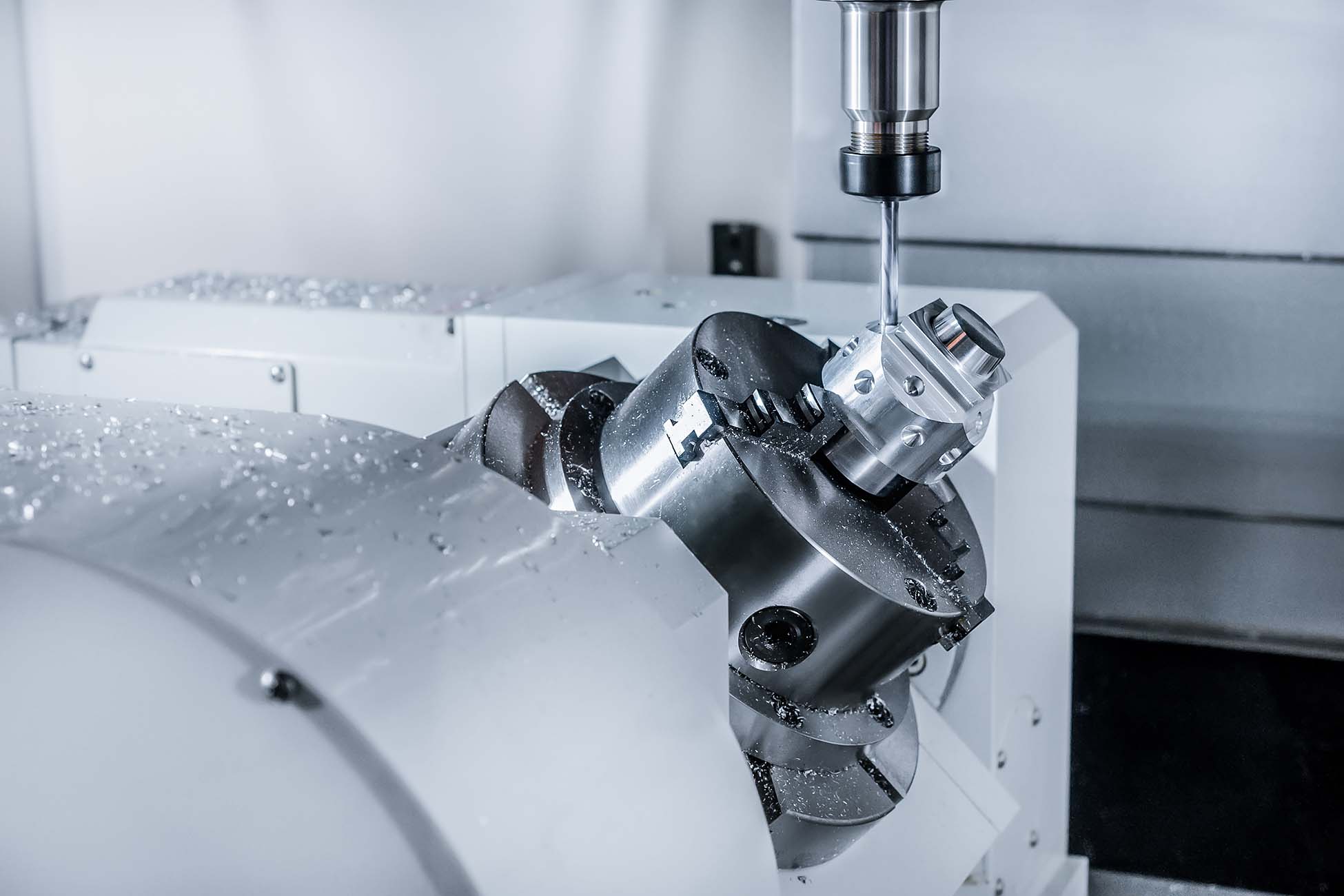
Custom CNC Machining Services
TFG provides precision CNC machining services for custom parts, delivering tight tolerances, repeatable quality, and efficient production. Utilizing advanced multi-axis CNC milling and turning, we support medium- and high-volume manufacturing across a wide range of industries.
Request a QuoteExtensive Expertise
Experience with precision CNC machining since 1980.
Advanced Technology
3-axis, 4-axis, and 5-axis milling machines to create high-quality products.
Quality Assurance
We employ coordinate-measuring machines and laser inspections to ensure the accuracy of every part.
Diverse Materials
We machine custom parts in brass, aluminum, steel, titanium, and more.
Industry-Specific Custom CNC Machining Services
At The Federal Group, our CNC machining services are designed to meet the specific needs of clients in a wide range of industries. We take a client-focused approach and make it a priority to offer quality products to manufacturing partners who produce medical devices, electronics, and industrial equipment, among others.

Medical Devices
As a leading CNC machining manufacturer, The Federal Group specializes in high-precision parts for medical devices and tools. Our commitment to quality ensures successful outcomes with complex surgical instruments and life-saving implants, where there’s a critical need for high precision and reliability.

Electronics
Our CNC milling services support the electronics industry by manufacturing intricate components for high-tech devices. From enclosures to connectors, we produce CNC machining parts with exacting tolerances. Our focus on precision ensures that each part meets the highest standards.

Industrial Equipment
The Federal Group provides custom CNC machining solutions for industrial equipment, delivering highly reliable components for heavy machinery, pumps, and valves. Our parts meet strict specifications to ensure optimal performance and durability even when subjected to harsh industrial environments.

Oil & Energy
The Federal Group USA provides CNC machining solutions for oil and energy applications including valve bodies, manifolds, pump housings, and drilling equipment components. Using advanced 3-axis, 4-axis, and 5-axis machining centers, we machine stainless steel, Inconel, titanium, and other high-performance alloys while supporting secondary processes such as heat treatment, passivation, and precision surface finishing.
Technology and Machinery

Above: A custom spline shaft machined by TFG USA.
TFG uses a range of CNC machining equipment and technologies to produce precision components across different geometries, materials, and production volumes. Our machining capabilities include 3-axis, 4-axis, and 5-axis CNC machining, allowing us to select the appropriate equipment and process for each part.
3-Axis CNC Machining
TFG provides 3-axis CNC machining for precision components with straightforward geometries and features such as pockets, slots, holes, and milled surfaces. 3-axis machines are well suited for efficient production of components where the workpiece can remain in a fixed position during machining.
Learn more about 3-axis CNC machining
4-Axis CNC Machining
Our 4-axis CNC machining capability adds rotary movement to the standard X, Y, and Z axes, allowing additional surfaces and features to be machined with fewer setups. This technology is useful for components that require machining around multiple sides while maintaining consistent positioning and accuracy.
Learn more about 4-axis CNC machining
5-Axis CNC Machining
TFG provides 5-axis CNC machining for complex components requiring access to multiple surfaces, angles, and intricate geometries. Simultaneous movement across five axes can reduce the number of setups required, helping improve dimensional consistency and production efficiency.
High-Standard Quality Control in CNC Machining
The Federal Group maintains the strictest quality assurance standards. We are certified under ISO 9001 and AS9100, ensuring our processes adhere to global benchmarks for quality and safety. These stringent measures ensure that every component we produce meets the precision metrics required to deliver exceptional customer service and reliability.
Our rigorous quality control processes and inspection methods include using Coordinate Measuring Machines, which are precision tools designed to measure the geometry of components. In addition to using CMMs, we also use laser inspections to ensure accuracy for every part. To maintain our commitment to quality, parts are delivered to customers only after passing a series of inspections and final checks.
CNC Machining Materials
TFG offers CNC machining in a wide range of metals, including common production materials and specialty alloys.
- 12L14 Steel: Free-machining steel for high-speed, precision machining and screw machine parts.
- Alloy Steel: Various grades for strength, hardness, toughness, and wear resistance.
- Aluminum: Lightweight, durable, and highly machinable.
- Brass: Excellent machinability, corrosion resistance, and conductivity. Brass is an excellent option for CNC machining.
- Carbon Steel: Low-, medium-, and high-carbon grades.
- Copper: Highly conductive and machinable.
- Duplex Stainless Steel: High strength and corrosion resistance for demanding environments.
- Inconel 718: High-temperature nickel alloy for demanding applications.
- Monel: Nickel alloy with excellent corrosion resistance.
- Stainless Steel: Multiple grades offering strength and corrosion resistance.
- Titanium: Lightweight, strong, and corrosion resistant.
- Tool Steel: High hardness and wear resistance for tooling and demanding components.
The CNC Machining Process
The CNC machining process is a subtractive manufacturing technique that involves the use of computer numerical control (CNC) machines to remove material from a workpiece and shape it into a desired form. The process typically includes the following steps:
- Design:
- The process begins with the creation of a digital 3D model or CAD (Computer-Aided Design) file. This design serves as the blueprint for the final product, specifying dimensions, tolerances, and other details.
- Programming:
- The CAD file is then translated into CNC machine code (typically g-code or m-code) by a programmer using CAM (Computer-Aided Manufacturing) software. This CNC programming code contains instructions for the CNC machine on how to move and position the cutting tools to achieve the desired part geometry.
- Workpiece Setup:
- The raw material, known as the workpiece, is secured in the CNC machine. This may involve clamping it in a vice, chuck, or other holding device depending on the machine type.
- Tool Selection:
- Appropriate cutting tools are selected based on the material of the workpiece and the features required in the final product. Different tools may be used for milling, turning, drilling, or other operations.
- Machine Calibration:
- The CNC lathe undergoes a calibration process to ensure accuracy in its movements. This calibration includes setting the zero points and reference positions for each axis.
- CNC Machining Operations:
- The CNC machine executes the programmed toolpaths, which involve precise movements of the cutting tools in relation to the workpiece. This can include milling, turning, drilling, or a combination of these operations.
- Material Removal:
- During machining, material is gradually removed from the workpiece according to the programmed instructions. The cutting tools create the desired shapes, features, and surface finishes.
- Quality Control:
- Periodic checks may be performed by machinists to verify the dimensions and tolerances of the machined features. This ensures that the final product meets the specified requirements.
- Finishing Operations:
- After the primary machining operations, additional processes like deburring, polishing, or heat treating may be applied to improve the final product’s aesthetics and functionality.
- Completion:
- Once the machining process is complete, the finished part is removed from the CNC machine. Depending on the complexity of the project, multiple setups or operations may be required to achieve the final product.
CNC machining is widely used across various industries due to its precision, efficiency, and versatility in producing complex parts with tight tolerances. It is applicable to a range of materials, including metals, plastics, and composites.
Advantages of CNC Machining

CNC machine tools can make quick, complicated cuts unmatched by other machinery. Using a computer-driven cutting tool to transform raw materials into a final product gives the client consistent product quality, better accuracy, and increased production speed. Depending on the part geometry, CNC machining can be ideal for prototyping.
Plus, the optimization greatly reduces defects. Inputs remain unchanged during the entire production process, cycle after cycle—and as long as they’re maintained and overseen by a trained machinist, machines can operate for long hours without compromising the quality of the product.

CNC machining is distinguished by built-in efficiencies, seamless scalability, and reduced energy consumption, all without compromises to the process or quality. All of this adds up to a process that can produce precision parts at a massively reduced cost of production.
What is the difference between CNC machining, milling, and turning?
CNC machining is a broad term that encompasses various manufacturing processes, including CNC milling and CNC turning. Here are the key differences between CNC machining, CNC milling, and CNC turning:
- CNC Machining:
- Definition: CNC machining is a general term for computer numerical control processes that involve the removal of material from a workpiece to achieve a desired shape.
- Processes: It includes a range of operations such as milling, turning, drilling, and other techniques performed with the assistance of computer-controlled machines.
- CNC Milling:
- Definition: CNC milling specifically refers to the process of using rotary cutters to remove material from a workpiece to create a specific shape.
- Operation: In CNC milling, the workpiece remains stationary while the cutting tool rotates, allowing for precise and controlled material removal. This process is ideal for creating complex shapes and features on a variety of materials.
- CNC Turning:
- Definition: CNC turning involves the rotation of a workpiece while a cutting tool moves in a linear fashion to shape the material.
- Operation: In CNC turning, the material is typically held in a chuck and rotated, and a cutting tool is applied to create cylindrical shapes such as tubes, shafts, and other symmetrical components. It is particularly effective for producing parts with rotational symmetry.
In summary, CNC machining is the overarching term that encompasses various manufacturing processes, while CNC milling and CNC turning are specific techniques within CNC machining. CNC milling involves rotary cutters and stationary workpieces, while CNC turning revolves around rotating workpieces and linearly moving cutting tools. Each technique is chosen based on the specific requirements of the desired end product.
What is the difference between Electrical Discharge Machining (EDM) and CNC machining?
- CNC Machining: CNC machining is a subtractive manufacturing process that involves removing material from a workpiece using cutting tools such as drills, mills, or lathes. The cutting tools physically remove material through various cutting actions.
- EDM: Electrical Discharge Machining, on the other hand, is a non-traditional machining process that relies on electrical discharges (sparks) to remove material. EDM doesn’t involve direct contact between the tool and the workpiece; instead, material is eroded through a series of controlled electrical discharges.
The Federal Group’s CNC Machining Services

When it comes to turning machines, CNC technology continues to evolve and innovate. At TFG, we design special machines that can be committed to long-term part programs. Our sales engineers will will make sure your CNC machined parts are manufactured to-print.
And as we look to continue to maximize efficiency with CNC machining, we’ve been creating robotic cells to optimize production flow. These robotic machines are programmed to complete coordinated and rapid movements, creating what amounts to an automated assembly line.
Start a CNC Machining Project Today

CNC machining has revolutionized the manufacturing industry—and we’d love to discuss the ways automation can revolutionize your next custom parts project. The finished product will meet your standards.
The Federal Group prides itself on our unparalleled engineering expertise in CNC machining. We’ve been providing precision CNC machining to clients since 1980, serving a wide range of industries, from small to large CNC machining projects. Our machine shop has the capacity to work on machined parts with tight tolerances and large volume productions.
Contact us today to get started on a custom project quote.




