
September 03, 2025
CNC Machining
Computer Numerical Control (CNC) machining has revolutionized modern-day manufacturing. It offers an unmatched level of precision, consistency, and automation in...
Read More

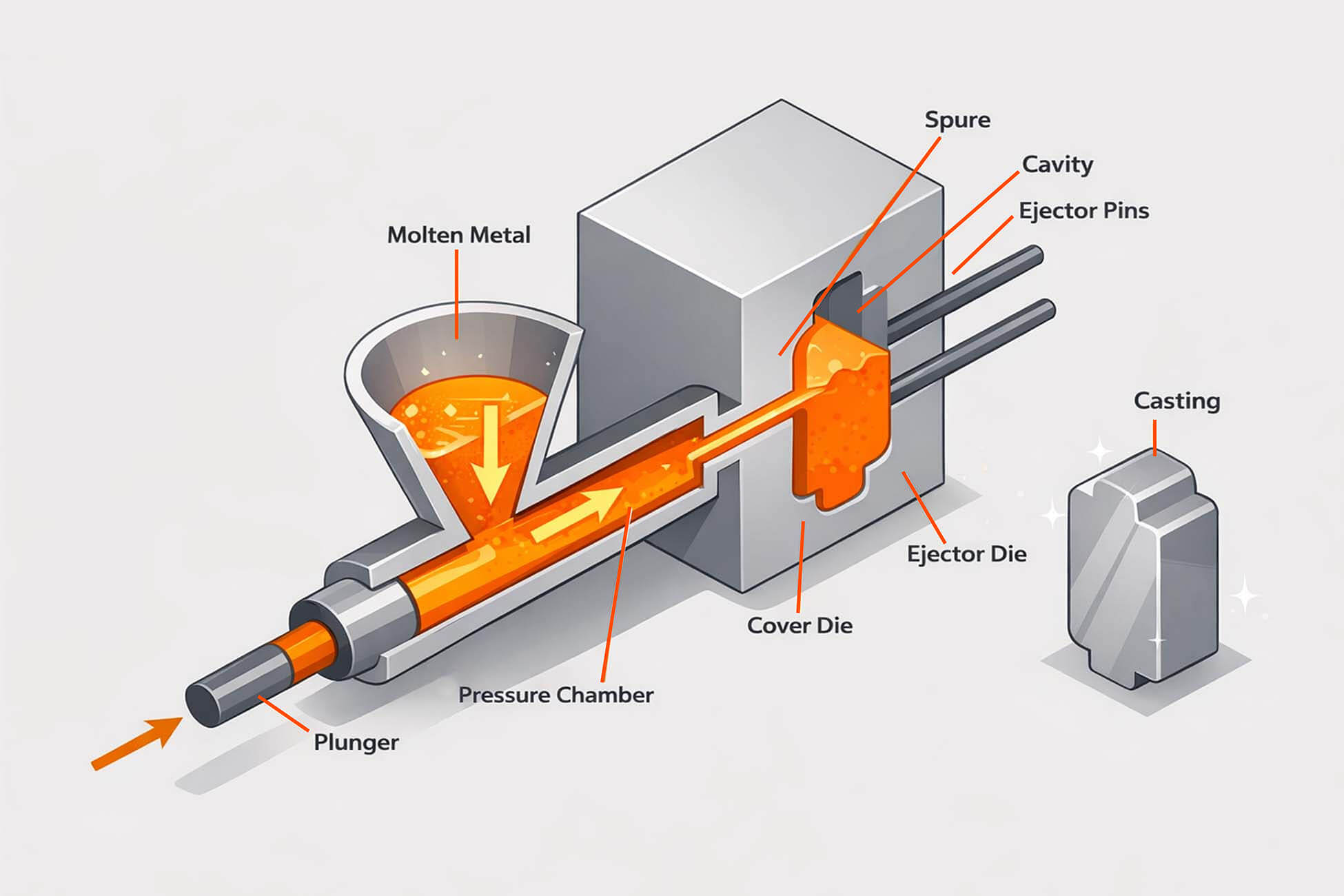
Die casting is a manufacturing process where molten metal is injected into hardened steel molds under high pressure to create precision metal parts. At The Federal Group, we employ die casting services to produce metal parts with exceptional speed, accuracy, and repeatability. Even when parts require smooth surface finishes and superior dimensional accuracy, die casting is one of the most efficient methods to produce complex components at scale with tight consistency from part to part.
Die casting is a metal casting process that is characterized by high dimensional accuracy and allows for the mass production of thin-walled products with complex shapes. Die casting also has the advantage of producing smooth casting surfaces requiring less machining after molding. Die casting uses permanent, hardened steel dies to produce tens of thousands—or even millions—of identical parts.
From mold preparation and injection to solidification and ejection, the following step-by-step process explains how die casting works and why it’s so effective for high-volume metal production.

In casting, a high-precision mold is called a “die.” Dies are machined from hardened steel and are built for long production life and consistent accuracy. Proper die design is critical to achieving part quality and efficiency. Before production begins, dies are cleaned, lubricated, and securely mounted into a casting machine. Because every component is formed within this steel die, its quality and tooling preparation directly affect how accurate, smooth, and consistent the finished parts are, as well as the final cost of each component.
Read our article on how to design a die casting mold.
Once it’s prepared, molten metal is forced into the die using high-pressure injection. This rapid fill pushes the metal cleanly into every cavity, which is why die casting works so well for parts with thin walls and complex geometries. The speed, precision, and consistency of this process enable the production of large volumes of identical precision components, over and over again, with the same die and tooling.
Every step of die casting is a speed-driven process optimized for fast, repeatable results. During the solidification phase, rapid cooling contributes to short cycle times, but it’s controlled to ensure the metal solidifies evenly and develops the required strength and dimensional stability. This controlled cooling and solidification process helps prevent defects and enables die casting operations to deliver repeatable, consistent accuracy from one part to the next.
Once the metal has fully solidified, the die opens automatically and the finished part is released through mechanical ejection. The casting is then separated from excess material left over from the mold filling step. Excess material includes runners (the channels that carry the molten metal into the die) and flash (thin metal that forms along the edges where the two die halves meet). Trimming this excess material creates the final part shape, followed by post-processing, which may include secondary machining, surface finishing, or inspection.
There are two main types of die casting processes: hot chamber die casting and cold chamber die casting. In evaluating hot chamber vs cold chamber die casting, both methods follow the same core principle of injecting molten metal into a steel die under high pressure, but the system used depends largely on the melting point and properties of the die casting materials, as well as the application requirements of the component.
Hot chamber die casting, best suited for lower-melting-point metals like zinc and magnesium, uses an injection system fully submerged in a bath of molten metal. This allows the machine to draw metal into the chamber and inject it into the die in a continuous, automated cycle.
In this method, the molten metal remains at a steady temperature and is always ready to be injected, supporting the fast cycle times and high-production efficiency that zinc die casting and magnesium die casting are known for.
Aluminum is an example of a metal with a higher melting point. At higher temperatures, some metals can chemically react with the hardened steel dies used in die casting, which can shorten equipment life. Instead, cold chamber systems are used for aluminum die casting and other high-melting-point alloys, including brass and bronze.
In cold chamber die casting, molten metal is ladled into a separate injection chamber before being forced into the die under high pressure. Keeping the die and tooling system out of the molten bath protects the equipment from heat and corrosion.

The most common materials used in die casting are aluminum, zinc, magnesium, and copper alloys. These nonferrous metals are selected for specific performance and manufacturing advantages, such as corrosion resistance, malleability, conductivity, or lightweight strength.
Each of these materials offers a different balance of strength, weight, durability, and cost-efficiency. Because material selection can influence whether fast cycle times are achievable, it directly impacts production speed and the final cost per part.
Read our case study on this aluminum die cast housing that we manufactured.
For high-volume production, die casting offers several advantages. However, it’s not without drawbacks, and taking a closer look at the pros and cons of die casting can help you make a more informed decision. Let’s take a closer look at die casting advantages and disadvantages.
Here are some of the advantages of die casting:
Here are the most common disadvantages of die casting:
With die casting, the benefits only pay off when certain conditions are met. Evaluating these tradeoffs early in the design process can help control costs and confirm that die casting is the right manufacturing method for your project.
When precise, repeatable metal components need to be produced at scale, die casting is often the most efficient and reliable manufacturing method available. Used to manufacture components for a wide range of industries, die casting is a strong choice for achieving tight tolerances with high-volume production for the following industries:
The ability to combine detail, durability, and production efficiency makes this process a practical choice for these industries, allowing them to produce complex shapes with die casting tolerances at scale.
Understanding when to choose die casting for your project depends on production volume, part complexity, and cost trade-offs. These three factors help determine whether die casting is a strong fit for your application and long-term manufacturing goals. Because of the higher setup costs and longer lead times, die casting is most effective when parts will be produced in medium to high volumes.
The best use cases for die casting include parts with complex geometries or thin walls that need to be produced at scale. Since die casting often reduces the need for secondary machining or extra finishing steps, overall costs can be lower over the life of a production program. The trade-off is a higher initial investment in exchange for lower per-part costs as production volume increases.
When selecting a manufacturing method, it helps to understand where die casting fits within other methods. Examining how die casting differs from processes like CNC machining and investment casting can help clarify your production strategy.
Die casting and CNC machining are both manufacturing methods used to produce high-quality precision parts. They ensure tight tolerances and dimensional accuracy with repeatable production.
When evaluating die casting vs CNC machining, the biggest differences come down to production volume and flexibility. With CNC machining, it’s easier to change a design during production, making this an ideal option for prototypes, custom parts, or low-volume production runs. Because it doesn’t require the specialized tooling and die setup, initial costs are typically lower.
For high-volume efficiency, however, die casting is a better choice. Once tooling is in place, die casting manufacturing supports faster production, consistent part quality, and lower cost per part at scale. When a part is ready for long-term, high-volume production, die casting makes more sense.
Investment casting is another manufacturing method used to produce components with complex geometries, dimensional accuracy, and good surface finishes. In die casting manufacturing as well as investment casting, it is well suited for applications where detail, repeatability, and part consistency are important.
When evaluating die casting vs investment casting, the key differences come down to how the molds are made and what that means for cost, speed, and flexibility. Investment casting uses disposable molds formed around wax patterns. This supports intricate shapes and designs, but this involves more steps and typically results in slower production times.
With die casting, the hardened steel dies are permanent once they are installed, making the process far more efficient for long-term production. While the upfront tooling costs are higher and design changes more costly, the trade-off is faster production and lower costs per part.
After looking at the pros and cons of die casting and how it stacks up to other manufacturing methods, it’s clear that good design is behind any successful die casting program. Design for die casting (DFM) focuses on creating parts that support smooth metal flow, consistent cooling, and reliable ejection from the mold. These features ensure a stronger component with fewer defects.
Uniform wall sections help molten metal fill the die more evenly, reducing stress points, porosity, and warping. Angles are another important consideration, since the part must release cleanly from the die once it’s ejected. Consolidation is another factor to consider when you’re manufacturing an assembly with multiple parts, since multiple components can sometimes be designed into a single die.
Surface finishes in die casting should also be taken into account, as well as early engineering and design-for-manufacturability to address these considerations up front, control costs, and avoid redesigns.
Die casting is often part of a larger manufacturing workflow. Secondary machining after die casting is often used when parts require tighter tolerances, threaded features, or precision interfaces. Common operations include CNC machining, drilling, tapping, anodizing, and powder coating.
Die cast parts may also undergo post-processing steps such as deburring, polishing, or painting. These finishing steps can not only enhance the appearance of manufactured metal components but also improve properties such as corrosion resistance, wear performance, and overall durability.
If you’re deciding whether die casting is right for your next project, early design guidance makes the process easier. Whether you need help evaluating your project, selecting a material, determining your production goals, or custom die casting services, The Federal Group USA is an ISO-certified die casting manufacturer that can answer your questions and help move your project forward with clarity.
Contact us to explore our die casting services and determine if this method is the right approach.

