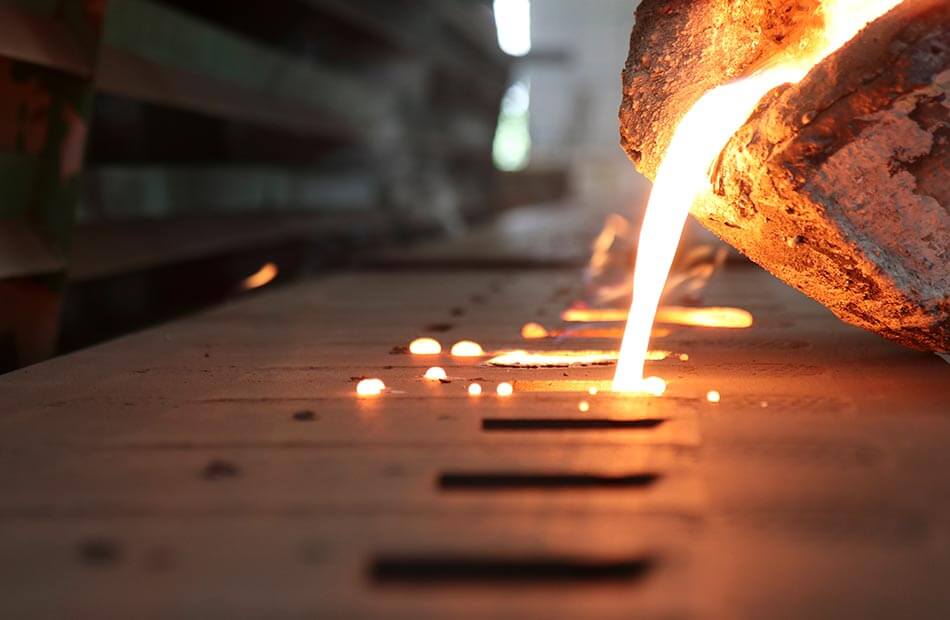
Green sand casting is one of the most widely used metal casting processes because it combines low tooling costs, material recyclability, and production flexibility. Made from a mixture of sand, bentonite clay, water, and additives, green sand molds allow foundries to produce complex metal components efficiently across a wide range of industries.
Table of Contents
Key Takeaways
- Green sand casting uses a reusable mixture of sand, bentonite clay, and water to create molds for producing metal components across a wide range of industries.
- The process offers low tooling costs, production flexibility, and compatibility with both ferrous and non-ferrous alloys, making it a cost-effective manufacturing solution.
- While green sand casting supports complex geometries and scalable production, secondary machining may be required to achieve tighter dimensional tolerances and improved surface finishes.
What Is Green Sand Casting?

Green sand casting is a metal casting process that uses a moist sand mixture to create molds for molten metal. Despite its name, the sand is not green in color—the term “green” refers to the fact that the mold remains wet and uncured during the casting process. Once molten metal is poured into the mold and allowed to cool, the sand mold is broken apart to reveal the finished casting.
Manufacturers use green sand casting to produce components from iron, steel, aluminum, bronze, and brass. The process is commonly chosen for medium-to-high volume production because it offers low tooling costs, accommodates complex geometries, and allows the molding materials to be reclaimed and reused.
How the Green Sand Casting Process Works
Green sand casting uses a reusable sand mixture to create molds for molten metal parts. While the process can vary by foundry and application, it generally follows the same core steps from pattern creation to final finishing.
1. Mold Creation
A pattern of the desired part is placed inside a flask, and green sand is compacted around it to create the mold cavity. If the design includes internal passages or hollow sections, sand cores are added before the mold is assembled.
2. Metal Pouring
Molten metal is poured into the mold through a gating system, filling the cavity and taking the shape of the final component.
3. Cooling and Shakeout
After the metal solidifies, the mold is broken apart to remove the casting. The used sand is then reclaimed and reconditioned for future production runs.
4. Finishing and Inspection
The casting undergoes finishing operations such as trimming, grinding, or machining as needed. Quality inspections are performed to verify that the part meets dimensional and performance requirements.
Advantages and Disadvantages of Green Sand Casting

Green sand casting offers a balance of affordability, versatility, and production efficiency, making it one of the most widely used metal casting processes. However, manufacturers should also consider its limitations when evaluating casting methods.
Advantages
- Low tooling and pattern costs
- Suitable for complex part geometries
- Compatible with ferrous and non-ferrous alloys
- Scalable for medium-to-high production volumes
- Reusable and recyclable molding materials
Disadvantages
- Rougher surface finish than precision casting methods
- Lower dimensional accuracy than investment or die casting
- Often requires secondary machining and finishing
- Potential for defects if sand properties are not properly controlled
Green Sand vs. Other Types of Casting Sand
Foundries use several types of molding sand, each designed for different casting requirements. Green sand remains the most common option because it offers low costs, fast production cycles, and reusable materials, but other sand systems may provide better surface finishes or tighter tolerances.
Green Sand vs. Dry Sand
Green sand molds contain moisture and are used immediately after molding, allowing for faster and more economical production. Dry sand molds are baked before pouring, creating a harder mold that can improve dimensional stability and surface finish but increases production time and cost.
Green Sand vs. No-Bake (Resin-Bonded) Sand
No-bake sand uses chemical binders instead of clay and water to hold the mold together. This process typically produces better dimensional accuracy and surface quality than green sand casting, making it a popular choice for larger, more complex castings. However, no-bake molds are generally more expensive and less recyclable.
Green Sand vs. Shell Mold Casting
Shell molding uses resin-coated sand that is cured against a heated metal pattern to create a thin, rigid mold. Compared to green sand casting, shell molding delivers tighter tolerances and smoother surface finishes but requires higher tooling costs and is typically reserved for more precise applications.
For many industrial components, green sand casting remains the preferred choice because it balances tooling costs, production efficiency, and design flexibility while supporting a wide range of metal alloys.
Green Sand Casting Versus Alternative Metal Casting Methods
Engineers constantly evaluate the trade-offs between sand casting and other methods to optimize unit economics. The specific part geometry and the required material dictate the best manufacturing approach.
Green Sand vs. Investment Casting
Feature | Green Sand Casting | Investment Casting |
Dimensional Tolerance | Achieves moderate tolerances that typically require secondary machining for precision fits. | Delivers exceptionally tight tolerances directly from the mold for complex geometries. |
Cost-Per-Part | Provides a highly economical cost-per-part for heavier components and larger production runs. | Carries a higher unit cost due to the consumable wax patterns and labor-intensive shelling process. |
Surface Finish | Yields a rougher RMS surface finish that reflects the grain size of the sand aggregate. | Produces a smooth, near-net shape surface finish that minimizes the need for extensive polishing. |
Green Sand vs. Die Casting
Feature | Green Sand Casting | Die Casting |
Production Volume | Scales effectively for medium-to-high volume production while accommodating heavier part weights. | Ideal for extremely high-volume runs of lightweight or thin-walled components. |
Tooling Costs | Features low tooling costs since match plates are inexpensive to produce and modify. | Requires massive upfront tooling costs to manufacture hardened steel permanent dies. |
Material Compatibility | Works well with high-melting-point ferrous metals like iron and steel. | Typically restricted to non-ferrous metals with lower melting points like aluminum and zinc. |
Green Sand Vs. Permanent Mold Casting
Feature | Green Sand Casting | Permanent Mold Casting |
Production Scalability | Offers flexible production scalability since foundries create a new mold for every single pour. | Requires continuous runs of high volumes to justify the cost of the reusable metal mold. |
Mold Longevity | Destroys the mold during the shakeout process, so mold wear is never a production issue. | Experiences thermal fatigue over time, so the permanent mold eventually requires costly replacement. |
Cooling Rates | Cools the molten metal slowly through the insulating sand, which affects the final grain structure. | Chills the metal rapidly against the steel mold, which typically increases the mechanical strength of the part. |
Frequently Asked Questions
What is green sand casting used for?
Green sand casting is commonly used to manufacture metal components for industries such as automotive, agriculture, construction, mining, energy, and industrial equipment. The process is well suited for producing complex parts, large castings, and medium-to-high production volumes while maintaining cost-effective tooling and manufacturing costs.
What is green sand made of?
Green sand is typically made from silica sand, bentonite clay, water, and performance-enhancing additives. The clay and water act as a natural binder that holds the mold together, while the sand provides the heat resistance needed to withstand molten metal during the casting process.
What are the advantages of green sand casting?
Green sand casting offers several advantages, including low tooling costs, material recyclability, design flexibility, and compatibility with a wide range of ferrous and non-ferrous alloys. These benefits make it one of the most widely used casting methods for manufacturers seeking a balance of production efficiency, scalability, and cost-effectiveness.
Conclusion
Transitioning a custom part into full-scale production requires a firm grasp of both material science and industrial workflows. Green sand for metal casting remains a foundational process because it balances upfront tooling efficiency with highly predictable unit economics. When paired with the right engineering oversight, this method provides a reliable path for scalable manufacturing.
Ready to Evaluate Your Green Sand Casting Project?
Every casting application has unique requirements for material selection, tolerances, production volume, and cost. Our engineering team can review your drawings, specifications, and production goals to help identify the most effective manufacturing approach.
Request a quote or contact TFG USA to discuss your sand casting requirements.
Holly Cacilhas
Quality Manager
Holly has over 18 years of experience in quality and has worked with brands such as Tesla, BMW, and Chrysler. She has led, trained, and managed teams between 25 and 400 people. Holly enjoys camping, boating, and spending time with her family.
Up Next


