Additive Manufacturing vs. Casting: How to Choose the Right Manufacturing Process
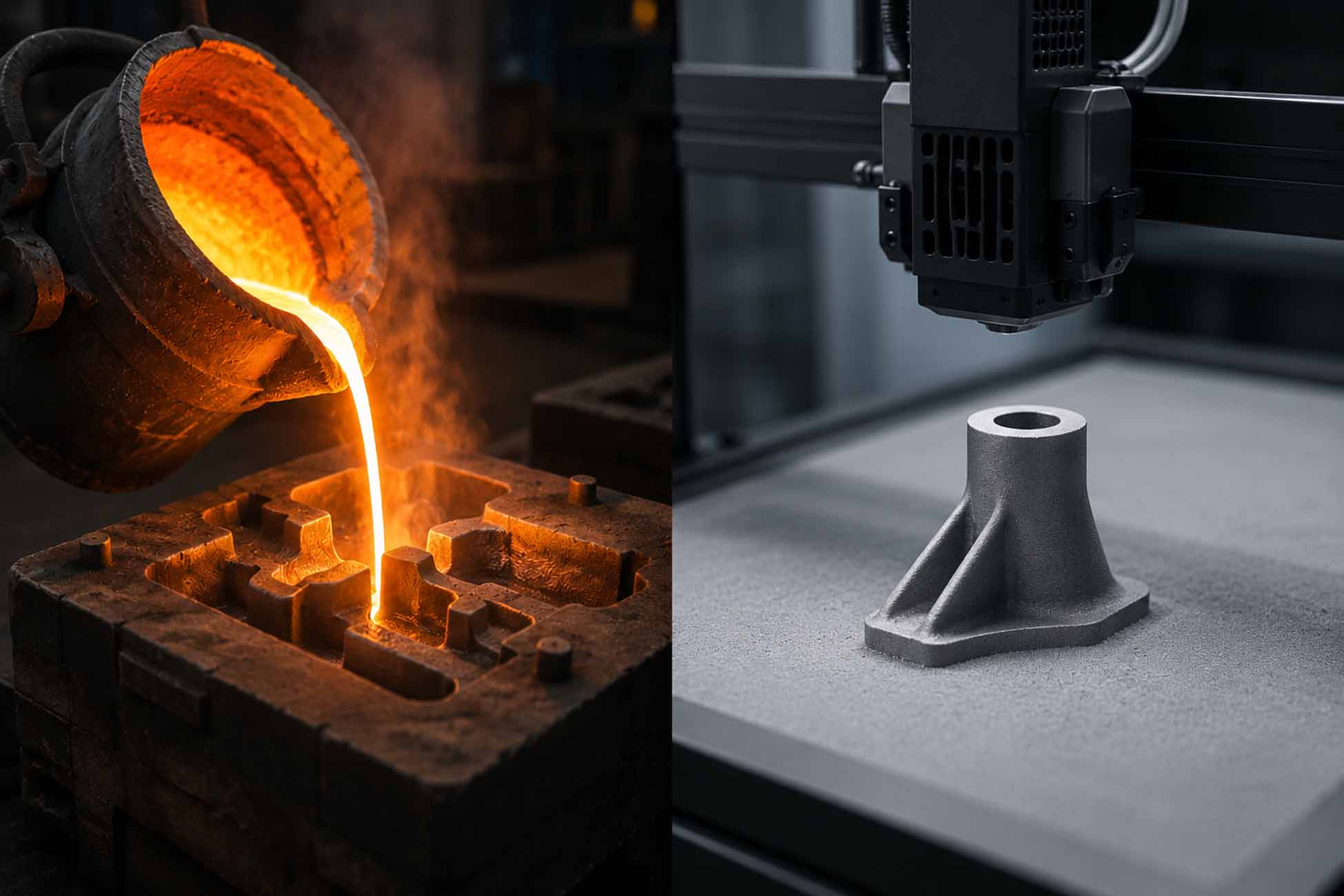
For decades, metal casting has been the preferred manufacturing process for producing durable, high-performance components at scale. More recently, additive manufacturing (AM), commonly known as metal 3D printing, has emerged as a valuable solution for prototyping and specialized production applications.
While both processes can produce complex metal parts, they serve different purposes. Choosing the right manufacturing method depends on factors such as production volume, part geometry, material requirements, lead time, and overall project cost.
In this guide, we’ll compare additive manufacturing and metal casting, explain where each process excels, and help you determine which solution best fits your application.
Table of Contents
What Is Additive Manufacturing?

Additive manufacturing builds a component layer by layer using a digital CAD model. Instead of removing material from a solid block or pouring molten metal into a mold, a metal 3D printer selectively fuses layers of powdered metal until the finished part is complete.
Common metal additive manufacturing technologies include:
- Direct Metal Laser Sintering (DMLS)
- Selective Laser Melting (SLM)
- Electron Beam Melting (EBM)
- Binder Jetting
Because no dedicated tooling is required, additive manufacturing is particularly valuable during product development and low-volume production.
What Is Metal Casting?

Metal casting is a manufacturing process in which molten metal is poured into a mold cavity and allowed to solidify into the desired shape. Depending on the application, different casting methods can be used to achieve specific mechanical properties, surface finishes, production volumes, and cost objectives.
Common casting processes include:
Casting has remained one of the most economical manufacturing methods for medium- and high-volume production because tooling costs are spread across many parts, significantly reducing the cost per component.
Additive Manufacturing vs. Casting: Key Differences
Although both processes produce metal components, they differ significantly in several areas.
Factor | Additive Manufacturing | Metal Casting |
Tooling | No tooling required | Mold or tooling required |
Production Volume | Low volume and prototypes | Medium to high-volume production |
Part Complexity | Excellent for intricate internal features | Excellent for complex external geometries |
Cost Per Part | Higher | Lower at production volumes |
Lead Time | Fast for prototypes | Longer initial setup, faster production once tooling is complete |
Part Size | Limited by printer build volume | Suitable for very small to extremely large components |
Material Options | Limited compared to casting | Wide selection of ferrous and non-ferrous alloys |
When to Choose Additive Manufacturing
Metal additive manufacturing is often the best option when flexibility and speed outweigh production costs.
Rapid Prototyping
Engineers can quickly validate designs without investing in permanent tooling, making design iterations faster and less expensive.
Low Production Quantities
If only a handful of parts are required, additive manufacturing often eliminates the need for expensive tooling that would be difficult to justify.
Highly Complex Internal Geometry
Metal 3D printing allows engineers to create internal cooling channels, lattice structures, and lightweight geometries that may be impossible or impractical to manufacture using traditional casting methods.
Custom Components
Medical devices, aerospace components, and specialized industrial equipment often require customized parts where additive manufacturing provides significant advantages.
When Casting Is the Better Choice
While additive manufacturing has expanded what’s possible in product development, casting remains the preferred manufacturing process for many production applications.
Medium- to High-Volume Production
Once tooling has been developed, casting offers substantially lower per-part costs than additive manufacturing. As production volumes increase, the economic advantages become even greater.
Large Metal Components
Many industrial castings weigh hundreds or even thousands of pounds—far exceeding the build capacity of current metal 3D printers.
Broad Material Selection
Casting supports an extensive range of materials, including:
- Carbon steel
- Alloy steel
- Stainless steel
- Aluminum alloys
- Brass
- Bronze
- Iron
This flexibility allows manufacturers to optimize strength, corrosion resistance, machinability, and wear performance for each application.
Proven Mechanical Performance
Casting processes have been refined over decades and continue to deliver reliable mechanical properties for demanding applications in construction equipment, agriculture, industrial machinery, mining, oil and gas, and renewable energy.
Cost Comparison
Cost is often one of the biggest factors when selecting a manufacturing process.
Additive Manufacturing Costs
Because there is little or no tooling investment, additive manufacturing can be the most economical option for prototypes and very small production runs. However, machine time, metal powder, and post-processing typically result in a higher cost per part.
Casting Costs
Casting generally requires upfront tooling investment. Once production begins, however, tooling costs are amortized across the production run, making casting significantly more cost-effective for medium- and high-volume manufacturing.
As annual production increases, casting typically becomes the more economical solution.
Can Additive Manufacturing and Casting Work Together?
Absolutely.
Rather than viewing additive manufacturing and casting as competing technologies, many manufacturers use them together throughout the product development cycle.
Examples include:
- Producing rapid prototypes before investing in production tooling
- Printing patterns or cores for investment and sand casting
- Validating part geometry before launching full production
- Accelerating product development while reducing tooling revisions
How to Select the Right Manufacturing Process
When evaluating additive manufacturing versus casting, consider the following questions:
- How many parts will be produced annually?
- What material properties are required?
- Does the design include highly complex internal features?
- Is tooling investment justified?
- What are the required lead times?
- Are tight tolerances or secondary machining required?
Answering these questions early helps determine the most cost-effective manufacturing approach.
Partner with TFG for Custom Metal Casting Solutions
Choosing between additive manufacturing and casting isn’t always straightforward. Every project has unique requirements based on production volume, part geometry, material selection, performance expectations, and budget.
At TFG, our engineering team helps manufacturers evaluate the most effective production method for every application. We offer custom sand casting, investment casting, die casting, permanent mold casting, and lost foam castingservices, along with comprehensive Design for Manufacturability (DFM) reviews to optimize quality, reduce costs, and streamline production.
Whether you’re transitioning from a prototype to full-scale production or determining if casting is the right solution for your component, get a quote today and let our manufacturing experts help bring your project to market.
Robert Levy
Manufacturing Business Leader
Owner of The Federal Group for 44 years, Robert is a serial entrepreneur and built his manufacturing business from scratch at the age of 26. He is an expert on all things forging, casting, and machining. On the weekends, he enjoys golfing, playing guitar, and spending time with family.
Up Next


