
Lost Foam Casting Supplier
The Federal Group USA provides custom Lost Foam Casting services for complex aluminum, iron, and steel components. Our end-to-end manufacturing process delivers near-net-shape castings, reduced machining requirements, and consistent quality backed by over 45 years of engineering experience.
Request a QuoteWhy Choose The Federal Group for Lost Foam Casting?
Managing the inherent technical challenges of evaporative-pattern casting requires strict manufacturing oversight. The Federal Group USA leverages deep engineering expertise to mitigate supply chain risk and help your custom metal parts meet exact specifications. Our approach focuses strictly on manufacturing excellence to deliver reliable results.
QMS 9001:2015 Certified
Rigorous quality inspections help ensure specification compliance and consistent casting performance from mold preparation through pouring.
Project Management
Dedicated program managers use AI-driven tracking across 60+ data points to provide seamless supply chain execution to your facility.
Metallurgical Control
We pour high-grade molten metals and use specific EPS-PMMA copolymers to actively prevent carbon defects and gas entrapment.
Complex Geometry
We employ advanced CNC milling and high-frequency vibration tables to yield intricate part geometries without draft angles.
Industries We Serve
We supply high-precision lost-foam casting components that meet the stringent demands of mid-to-large scale industries. Our process achieves tight-tolerance dimensions for critical applications across multiple sectors.

Medical Component Manufacturing
TFG uses lost foam casting to produce complex housings, imaging system components, pump bodies, compressor housings, and equipment frames. The process delivers excellent dimensional accuracy and repeatability for critical components used in diagnostic, laboratory, and healthcare applications.

Construction Equipment
Lost foam casting is ideal for producing complex construction equipment components that require high strength, dimensional accuracy, and reduced machining. We manufacture durable aluminum, iron, and steel castings for heavy-duty applications, helping OEMs improve performance while controlling production costs.

Energy Industry
Lost foam casting supports the production of energy industry components including valve bodies, pump housings, turbine components, compressor casings, heat exchanger parts, and flow control equipment. The process accommodates complex geometries and demanding material requirements for applications in power generation, oil and gas, and renewable energy systems.
Specific Machinery and Technology We Employ
Achieving strict net-shape accuracy requires advanced technology at every step of the production process.
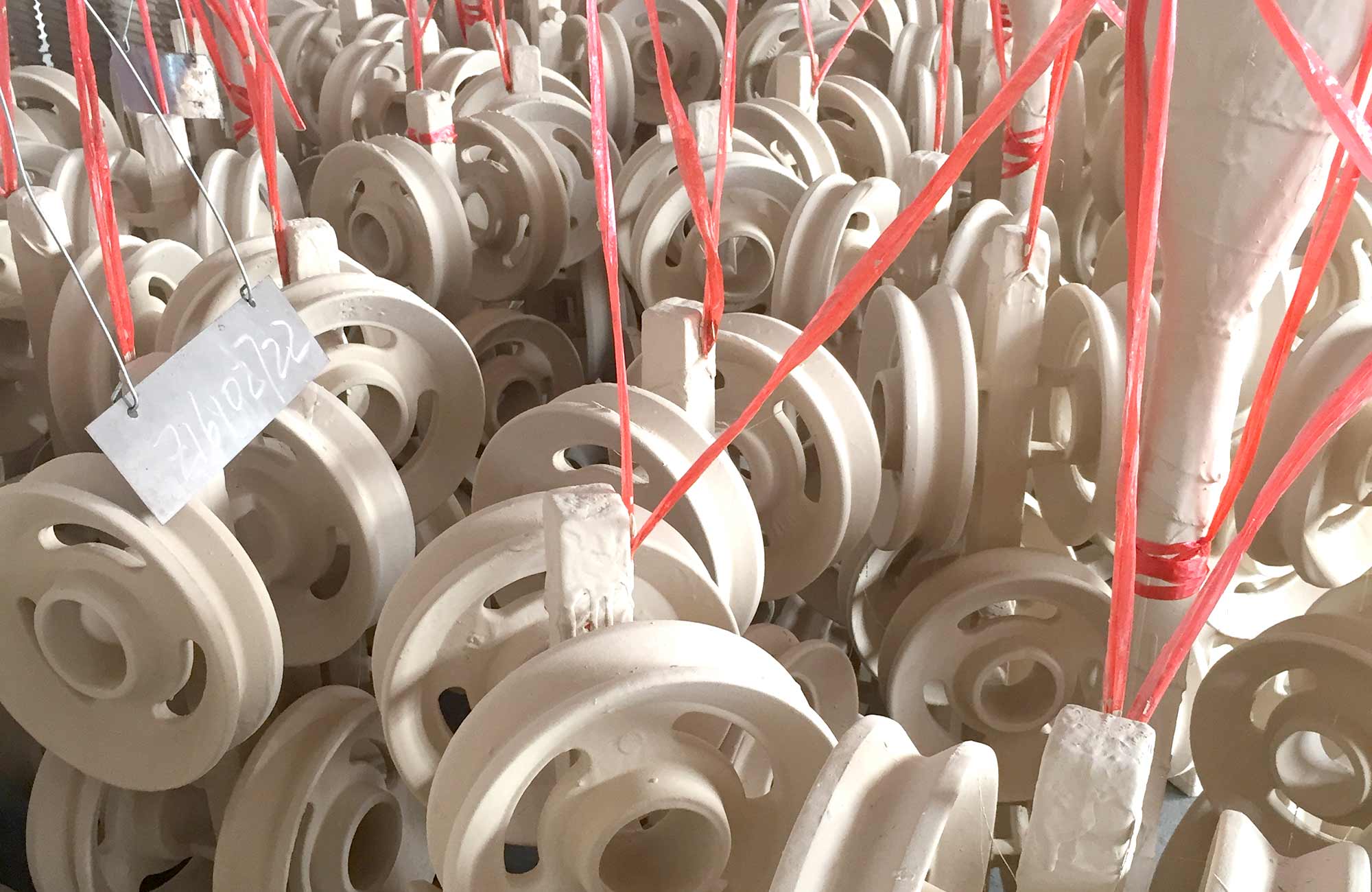
Pattern creation begins with advanced 5-axis CNC routers cutting Extruded Polystyrene (XPS) and EPS raw foam to exact dimensions. These patterns then move through automated refractory slurry dipping stations to carefully control coating permeability. Operators place the coated patterns into the mold cavity, and high-frequency vibration tables promote optimal sand compaction around the complex shapes.
Our facility produces parts ranging from approximately 0.5 lbs up to 500 lbs. You can expect tight linear tolerances of typically ±0.005 in/in depending on the specific tooling and part geometry. Automated pouring systems strictly control the delivery rate to help prevent short pours, so the molten metal can completely replace the vaporized foam.
Specific Lost Foam Casting Materials We Use

We process a wide range of molten metals to match your specific application requirements. Our engineering team strictly controls the pouring process to promote optimal mechanical properties for every component.
- Aluminum alloys: Materials like A356 and 319 provide lightweight, corrosion-resistant parts with excellent surface finish quality.
- Carbon steel: This metal delivers the high-strength characteristics required for heavy machinery and demanding structural components.
- Ductile iron: This material is ideal for high-volume structural applications requiring long-term durability and wear resistance.
When pouring high-carbon cast irons, we use advanced EPS-PMMA copolymers instead of standard EPS. This specific material choice actively prevents metallurgical defects like carbon pickup or lustrous carbon formation.
Secondary Processes and Finishing Capabilities
The foam pattern is initially coated in a permeable refractory slurry to support a superior as-cast surface finish quality. This refractory coating acts as a primary method for defect prevention, yet secondary finishing is often necessary for critical mating surfaces. We offer comprehensive post-casting services to complete your parts.
- Precision CNC Machining: We use advanced machining centers to achieve ultra-tight final tolerances on critical dimensions and mating surfaces.
- Thermal Heat Treating: Processes like annealing, tempering, and quenching optimize the mechanical properties and relieve internal stress.
- Surface Finishing Solutions: We apply powder coating, anodizing, passivation, and anti-corrosion plating prior to final multi-part assembly.
Request a Lost Foam Casting Quote
Looking for a reliable lost foam casting supplier? The Federal Group USA delivers complex cast components with the quality, consistency, and engineering support needed for successful production programs.
Send us your drawings, CAD models, or project requirements for a comprehensive review. Our engineering team will evaluate your design, recommend manufacturing improvements where applicable, and provide a competitive quotation to help move your project forward quickly and cost-effectively.
Frequently Asked Questions
What Is the Lost Foam Casting Process?
The lost foam casting process follows five distinct steps to turn a foam model into a final metal part:
- Pattern creation: Operators cut or mold Extruded Polystyrene (XPS) or EPS foam into the exact shape of the desired part.
- Coating application: The foam pattern is dipped in a permeable refractory slurry to create a protective outer shell.
- Investment and embedding: The coated pattern is placed in a flask and surrounded by unbonded sand, and this is compacted using high-frequency vibration.
- Metal pouring: Molten metal is poured directly onto the pattern, causing the foam to vaporize so the metal can fill the exact cavity left behind.
- Cooling and cleaning: Once the metal solidifies, the unbonded sand is removed, and the final casting is cleaned of any remaining refractory coating.
Is Lost Foam Casting Better Than Sand Casting?
Determining whether lost foam casting is better than traditional sand casting depends entirely on your specific project requirements, as neither process is universally superior.
Lost foam casting is the better choice for producing highly complex, intricate geometries without draft angles and provides a seamless finish by avoiding traditional parting lines. Additionally, it offers a superior as-cast surface finish and becomes highly cost-effective during complex, high-volume production runs.
Conversely, traditional sand casting remains the preferred method for simpler geometries with standard draft angles and is typically more economical for lower-tolerance parts that don’t require the advanced precision of foam-based techniques.
What Kind of Foam Is Used for Lost Foam Casting?
Manufacturers primarily use Expanded Polystyrene (EPS) and Extruded Polystyrene (XPS) for this process. The raw EPS is expanded from polystyrene pellets, and the final foam density must be carefully selected based on the specific part.
Lower density foam vaporizes easier but yields a rougher surface finish, while higher density foam provides better intricate detail but increases the risk of gas entrapment during pouring.
What Is One of the Limitations of the Lost Foam Casting Process?
A primary limitation is the risk of gas entrapment if the refractory coating lacks proper permeability to let gases escape during vaporization. Other challenges include the fragility of the raw foam patterns during handling and the technical difficulty of managing pouring speed to prevent short pours or mold collapse.
What Is Another Name for Lost Foam Casting?
It’s also formally known as evaporative-pattern casting (EPC).




