Scaling complex metal components to high-volume production requires casting methods that reduce excessive secondary operations. Lost foam casting companies allow engineering teams to achieve near-net-shape tolerances on intricate internal passageways without the high tooling costs associated with traditional molds. Understanding this evaporative-pattern method provides a clear framework for optimizing your next medium to large volume production runs.
Table of Contents
Key Takeaways
- Lost foam casting removes the requirement for core making and allows for highly complex geometries in a single pour.
- The process uses an evaporative polystyrene pattern that vaporizes upon contact with molten metal.
- Unbonded sand supports the pattern during the pour to reduce parting line defects and draft angle requirements.
- Engineering teams rely on this method to scale custom metal components while keeping secondary machining costs low.
What Is Lost Foam Casting?
Lost foam casting is an evaporative-pattern casting process used to produce complex metal parts with tight tolerances. Often referred to as foam lost casting, this method relies on a polystyrene pattern that is identical to the final desired part. Instead of removing the pattern from the mold before the pour, foundry workers leave the foam in place and pack unbonded sand around it.
When the molten metal enters the mold, the extreme heat vaporizes the foam instantly so the metal accurately fills the resulting cavity. This technique removes the need for traditional parting lines and cores, and this makes it highly effective for intricate geometries.
The 5-Step Lost Foam Casting Process
The foundry process requires strict temperature controls and precise material handling to ensure high dimensional accuracy. Every phase of the pour demands cross-functional quality inspections to prevent sand collapse and manage gas escape during vaporization.
1. Creating the Foam Pattern
The first step answers a common material question regarding what kind of foam is used for lost foam casting. The process primarily uses polystyrene or EPS foam to create the exact foam pattern of the final component.
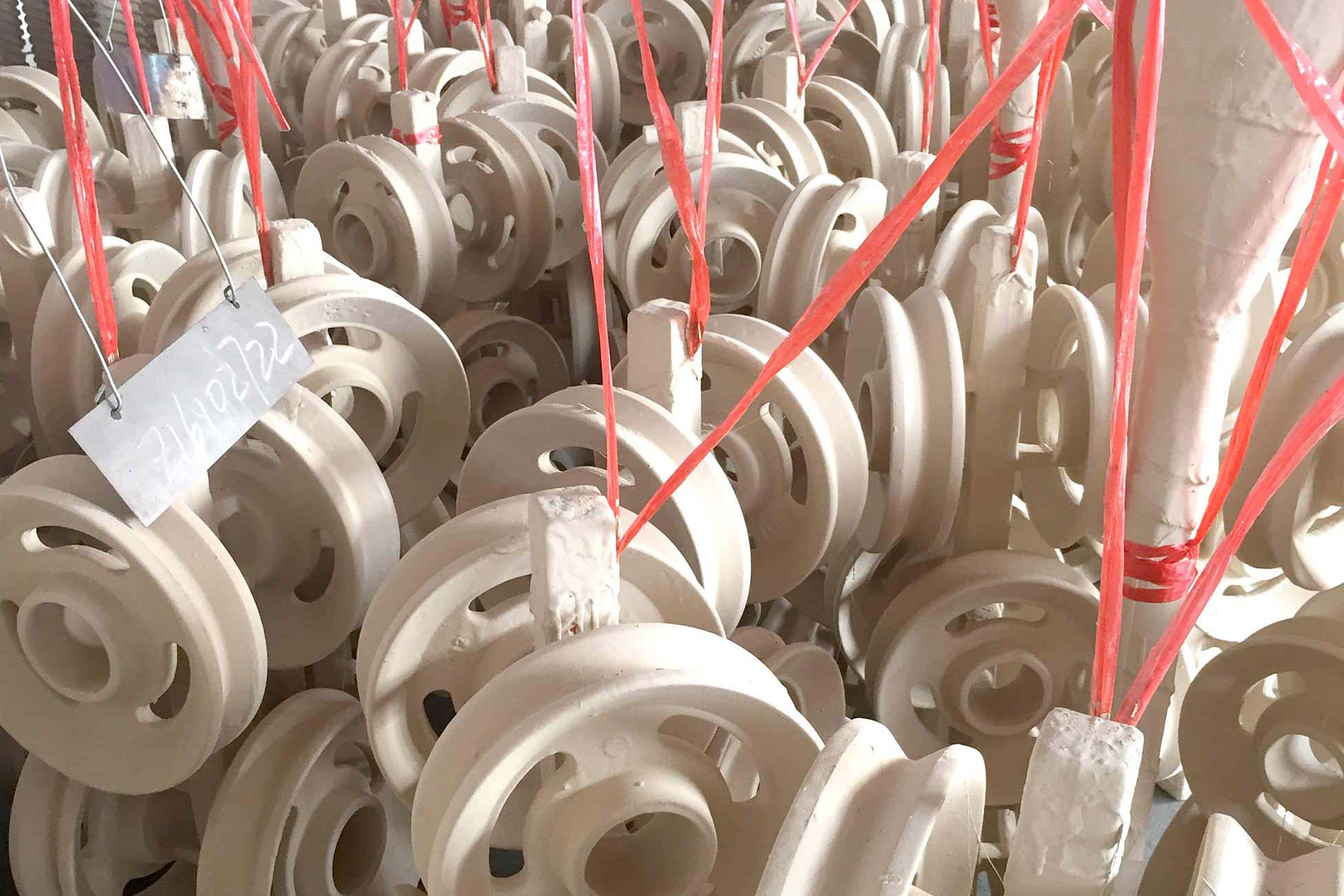
For high-volume runs, manufacturers inject expandable polystyrene beads into an aluminum die and apply steam to expand and fuse them together. Prototyping and low-volume testing phases often rely on CNC machining to carve the pattern directly from a solid block of EPS-PMMA copolymers.
2. Attaching Risers and Sprues
Once the primary shape is complete, technicians build the gating system and sprues required to guide the metal into the mold. This pattern assembly phase involves gluing multiple foam pieces together along with pouring cups and risers. The precise design of this gating system dictates the flow rate of the metal and prevents turbulence during the final pour.
3. Applying the Refractory Coating
The entire foam assembly is then dipped into a liquid refractory coating and dried in a controlled environment. This ceramic shell provides the necessary gas permeability to let vaporized foam escape while holding the surrounding sand in place. A properly applied coating dictates the final surface finish of the casting and prevents molten metal from penetrating the mold walls.
4. Burying the Pattern in Unbonded Sand
The coated foam pattern goes into a steel flask where it is completely surrounded by unbonded sand or loose sand. Unlike traditional sand casting, this method doesn’t require chemical binders to hold the sand together. Instead, technicians use continuous flask vibration to ensure complete sand compaction around every intricate detail and internal cavity of the pattern.
5. Pouring the Molten Metal and Shake-Out
Foundry operators pour the molten metal directly into the pouring cup at a highly controlled pouring temperature. The heat vaporizes the foam instantly, and the liquid metal replaces the exact volume of the vanished pattern.
After the metal solidifies, the shake-out and cleaning phase is remarkably simple because the loose sand falls away easily. This reduces the risk of common casting defects and limits the need for heavy post-pour processing.
Key Advantages and Industrial Applications
Engineering teams frequently ask what lost foam casting is used for when evaluating different manufacturing routes. The method is primarily used to produce complex metal parts that require intricate internal passageways and tight casting tolerances. Its net-shape capabilities make it highly cost-effective for mass production because it can reduce the need for secondary machining by up to 50% or more depending on the geometry.
- Heavy machinery components: The process creates durable pump housings and valve bodies with complex internal flow paths.
- Agricultural equipment parts: This method produces rugged custom metal components capable of withstanding high-stress field conditions.
- Energy sector hardware: Engineers rely on this technique to manufacture precise motor casings and compressor components for industrial applications.
These industrial applications benefit from the absence of core shifts, so manufacturers can maintain strict dimensional accuracy across large production volumes.
Comparing Casting Methods for High-Volume Production
Selecting the optimal manufacturing route requires a clear understanding of how different foundry processes handle complex geometries and tooling budgets. Engineering teams must evaluate the specific trade-offs of each method to control costs and maintain dimensional accuracy.
Lost Foam Casting vs. Sand Casting
Engineers often ask if lost-foam casting is the same as sand casting when reviewing production options. Both methods use sand to form the exterior of the metal part, but their internal mechanics and material requirements are completely different.
Feature | Lost Foam Casting | Traditional Sand Casting |
Mold Material | This method uses unbonded sand packed around a consumable foam pattern. It doesn't require any chemical binders to hold the mold together. | This process relies on sand mixed with clay and chemical binders. The sand must hold its shape after the pattern is removed. |
Geometric Complexity | The foam stays in the mold during the pour, so there are no parting lines. Engineers don't need to design draft angles or use separate cores. | The solid pattern must be removed before pouring, which creates visible parting lines and requires draft angles. Complex internal cavities demand expensive sand cores. |
Tooling and Setup | The polystyrene pattern vaporizes instantly upon contact with the molten metal. A new foam pattern is required for every single casting. | The foundry uses a reusable wood or metal pattern to stamp the cavity into the sand. This single pattern can produce thousands of molds. |
Lost Wax vs. Lost Foam
Evaluating what the difference is between lost wax (investment casting) and lost foam is critical when planning for high-precision components. Both are consumable pattern processes, but they serve different production volumes and tolerance requirements.
Feature | Lost Foam Casting | Investment Casting (Lost Wax) |
Pattern Material | Foundries create the initial shape using expanded polystyrene or EPS foam. The foam vaporizes and leaves a slight bead texture on the final surface. | Technicians inject liquid wax into a precision die to create the pattern. The wax melts out of the ceramic shell to leave an exceptionally smooth surface finish. |
Tooling Costs | The aluminum dies required to mold the foam patterns carry moderate upfront tooling costs. This makes the method highly scalable for medium to large volume production runs. | The precision dies required for wax injection carry tooling costs that are often 20% to 50% higher than standard aluminum foam dies. This investment is necessary to achieve extreme micron-level tolerances and complex geometries. |
Part Size and Complexity | This process scales easily for very large and heavy components like engine blocks. It handles complex internal cavities without the risk of fragile ceramic shell breakage. | Investment casting is typically reserved for smaller components like turbine blades. The heavy ceramic shells can become difficult to manage on massive parts. |
Transitioning Your Prototype to High-Volume Production
Moving from a single machined prototype to a full production run requires a rigorous engineering feasibility review. Choosing the optimal casting method demands a manufacturing partner capable of executing at scale without sacrificing dimensional accuracy. The Federal Group USA is a leading U.S.-owned manufacturing partner that helps engineering teams turn prototypes into medium- to high-volume production runs.
We manage the full production lifecycle, from initial design review to final logistics. Our engineering and quality teams rely on strict QMS 9001:2015 Certified standards and cross-functional quality inspections to ensure every custom metal component meets exact built-to-print specifications. This structured approach reduces raw material waste and keeps secondary machining costs firmly under control.
Conclusion
Selecting the right foundry process dictates the financial success of your entire project. Lost foam casting provides a distinct advantage for intricate internal passageways, so it often outperforms traditional methods in both speed and material efficiency. This evaporative-pattern casting technique removes the limitations of standard draft angles and parting lines. Understanding these variables gives your engineering team a clear framework to design better parts and streamline your manufacturing workflows.
Frequently Asked Questions
Is Lost Foam Casting Expensive?
Lost foam casting is highly cost-effective for mass production, though the initial tooling costs for the aluminum foam dies can be higher than simple sand casting patterns. The process offsets these upfront expenses by eliminating the need for complex internal cores and heavy secondary machining.
This method also drives raw material waste reduction, often lowering scrap rates by 10% to 30% because the near-net-shape capabilities require less metal per part. The lower per-unit labor and machining costs typically make it much more economical than traditional alternatives for large runs.
What Metals Can Be Poured Using the Lost Foam Process?
Foundries can pour a wide variety of commercial alloys using this evaporative process. Aluminum remains one of the most common choices because its lower pouring temperature interacts well with the polystyrene patterns.
The method is also highly effective for pouring cast iron and steel components that require intricate internal geometries and high structural integrity. Material selection ultimately depends on the specific strength requirements and built-to-print specifications of the final application.
Robert Levy
Manufacturing Business Leader
Owner of The Federal Group for 44 years, Robert is a serial entrepreneur and built his manufacturing business from scratch at the age of 26. He is an expert on all things forging, casting, and machining. On the weekends, he enjoys golfing, playing guitar, and spending time with family.
Up Next

