
June 10, 2026
What Is Vacuum Investment Casting?
Standard investment casting works well for common alloys, but introducing highly reactive metals or intricate geometries requires specific environmental controls...
Read More

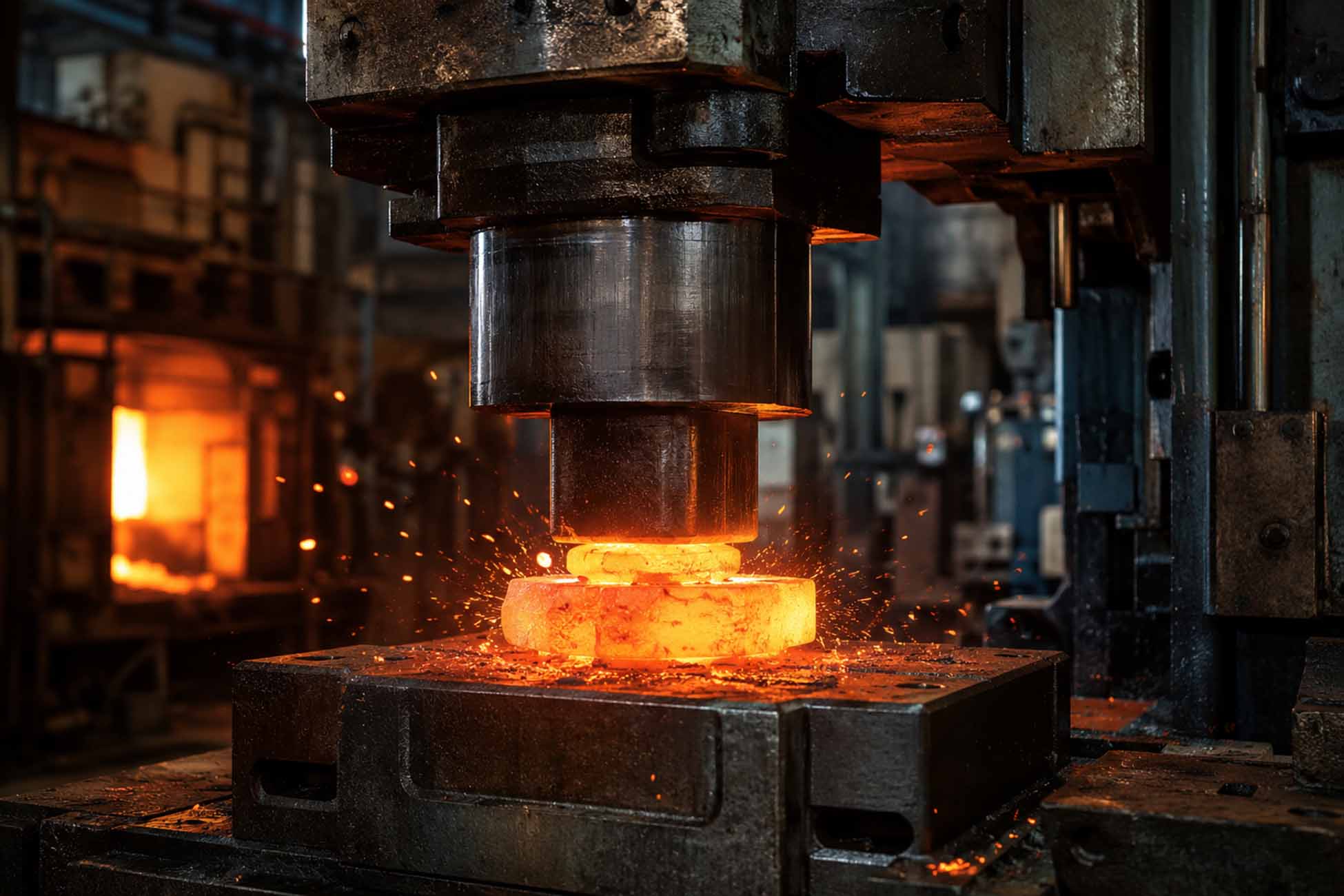
Drop hammer forging relies on massive kinetic energy to compress solid metal into highly durable custom shapes. By dropping a heavy ram onto a pre-heated billet, this process forces the material to fill a custom impression die, physically aligning the internal grain structure with the contours of the part.
This metallurgical transformation creates the exceptional fatigue resistance required for high-stress applications. Understanding exactly how this mechanical process works provides a clear framework to evaluate tooling investments, compare manufacturing methods, and secure a resilient supply chain for your next high-volume production run.
Table of Contents
Drop hammer forging is a specialized metal shaping process that uses a falling heavy weight to compress a pre-heated metal billet into a specific shape. A massive ram drops onto the hot metal to force the material into the cavities of a custom die.
This intense impact aligns the internal grain structure of the metal with the physical contours of the component. The result is a highly durable part designed for high-stress environments.
This method is highly effective for producing high-strength custom metal components in medium- to high-volume production settings.
Hammer forging is a broad category of metalworking where repeated impacts shape a workpiece. Drop forging is a specific type of hammer forging that relies on a vertical stroke to drop a ram straight down onto the metal.
Most industrial drop forging is also known as impression die forging because the metal is forced into a closed custom mold to achieve precise dimensions. Unlike open die forging, which shapes metal between flat or simple dies without fully enclosing the material, drop forging uses custom impression dies to achieve more defined part geometries.
The drop forging process begins by heating a metal billet in a furnace until it reaches an optimal forging temperature. Operators then place this pre-heated metal onto the bottom half of the custom tooling. A heavy ram holding the top half of the die falls from above to strike the metal.
This strike relies on either pure gravity or added mechanical power to deliver massive kinetic energy. Multiple blows force the metal to flow into every corner of the die during the shaping phase.
Excess metal escapes the edges of the die to help build internal pressure so the material completely fills the cavity. This excess material is called flash.
After the forging steps are complete, a secondary trimming or shearing process removes the flash to reveal the final engineered shape.
Manufacturing facilities use three primary types of drop forging hammers to generate the necessary impact force against the stationary anvil.
The primary advantage of a drop hammer is the physical transformation of the internal grain structure of the metal. Machining cuts through the natural grain of a metal block, and casting creates a random grain structure as molten metal cools.
Drop forging compresses and aligns the grain flow to match the exact shape of the part. This continuous grain flow reduces internal voids and creates exceptional structural integrity.
These high-strength properties make the process ideal for mass production of critical components used in heavy machinery and infrastructure.
A drop forged part offers some of the highest fatigue resistance available in metal manufacturing. The impact of the hammer refines the metallurgical properties of the alloy and minimizes the porosity often found in cast parts.
This dense continuous structure allows the component to withstand repeated stress and heavy load cycles without cracking. Engineers specify this method for critical applications because the aligned grain flow mitigates the risk of component failure and supports long-term field reliability.
The initial tooling setup for drop forging requires a dedicated investment because engineers must design and machine highly durable impression dies. Yet this method provides excellent cost-effectiveness over the life of a project.
The fast cycle times and minimal material waste keep the per-unit price low once the dies are active. This makes drop forging highly economical for medium- to high-volume production runs.
A manufacturing partner can help you calculate the exact break-even point so volume production aligns with your budget.
Selecting the right metal shaping process depends on the specific requirements of your custom metal components. Drop forging offers distinct advantages, so evaluating it against alternative methods helps clarify the best path for your production run.
Manufacturing Method | Force Application | Strain Rate And Impact |
Drop Forging | Uses repeated high-velocity strikes from a falling ram to shape the metal. | High strain rate creates rapid deformation inside the impression die forging setup. |
Press Forging | Uses a mechanical press to apply continuous steady pressure over time. | Lower strain rate allows the metal to flow more evenly and slowly throughout the die cavity, reducing the immediate impact force. |
Manufacturing Process | Strength & Performance | Production Efficiency |
Drop Forging | Aligns the internal grain structure of the metal to create superior strength, fatigue resistance, and impact durability. | Ideal for medium- to high-volume production with low material waste after tooling is complete. |
Casting | Produces complex shapes by solidifying molten metal but typically provides lower fatigue strength than forged components. | Cost-effective for intricate geometries but may require secondary machining or finishing operations. |
Machining | Delivers precise dimensions and tight tolerances by removing material from solid stock, but does not improve grain structure like forging. | Excellent for prototypes and precision parts but may create higher material waste during volume production. |
Transitioning a successful prototype into medium- to high-volume production requires careful planning to prevent scaling issues. A successful drop forging project relies heavily on upfront design for manufacturing (DFM) to optimize the part geometry for the die. This engineering review minimizes material waste and verifies the component can handle the intense impact forces required for shaping.
As a leading U.S.-owned provider of metal forging services, The Federal Group USA manages the entire production process, from engineering support and tooling development through quality control and global delivery.
Moving from prototype to production forces teams to balance upfront tooling costs with long-term part performance. Drop hammer forging aligns the internal grain structure to deliver the fatigue resistance required for high-stress applications.
Understanding this process allows you to confidently evaluate die investments and choose a method that supports reliable production runs at scale.
Partnering with an experienced manufacturing team helps your next project transition smoothly from initial design to final delivery. Reach out to The Federal Group USA to discuss your component specifications and explore how our end-to-end manufacturing solutions can support your supply chain.
Forged is a general term that applies to any metal shaping process using localized compressive forces to alter a workpiece. Drop forged refers specifically to a method where a heavy ram falls vertically to strike the metal.
Both methods typically involve hot forging to make the material malleable before impact. Drop forging simply specifies the exact mechanical setup used to deliver the force.
Maintaining precise temperature control and engineering accurate dies are critical to a successful forging run. Proper execution prevents issues like incomplete die filling or uneven internal grain flow.
Secondary operations focus on accurate flash removal to maintain the final dimensions of the part. Strict quality control and upfront engineering reviews manage these variables to support the structural integrity of the final component.

Richard has been on The Federal Group team for 24 years and his knowledge spans a variety of mechanical engineering topics. When he isn't assisting his clients, he is routinely working on his motorcycles and off-road vehicle projects.
This site uses cookies and similar technologies. See our Privacy Policy for details.
Manage your cookie preferences below:
Essential cookies enable basic functions and are necessary for the proper function of the website.