
August 27, 2026
Cold Forming
Cold forming is a metalworking process that uses pressure to shape metal at or near room temperature, producing strong, precise...
Read More


Sand casting is a metal casting process that uses a mold made from compacted sand to form molten metal into a desired shape. The mold is created around a pattern, and after the metal solidifies, the sand mold is broken away to remove the finished casting.
Sand casting is one of the most versatile metal casting processes because it can produce both small and very large components in a wide range of ferrous and non-ferrous alloys. It is commonly used for low- to medium-volume production where flexibility, large part sizes, and relatively low tooling costs are important.
Using sand to cast metal is the oldest metal casting method and one of the most versatile. The earliest recorded use of sand casting is from around 1540.
It wasn’t until the high demand for automobiles and machines that the sand casting process would become fully automated. This increase in demand also led to technological advances in sand casting including increased molding speed and improved strength of the molds.

Sand casting uses a sand mold to create a cavity that is filled with molten metal. Once the metal solidifies, the sand mold is broken away and the casting is cleaned, inspected, and machined as needed.
These components work together in the sand casting process to create the cavity into which molten metal is poured, solidified, and cooled to form the final cast part.
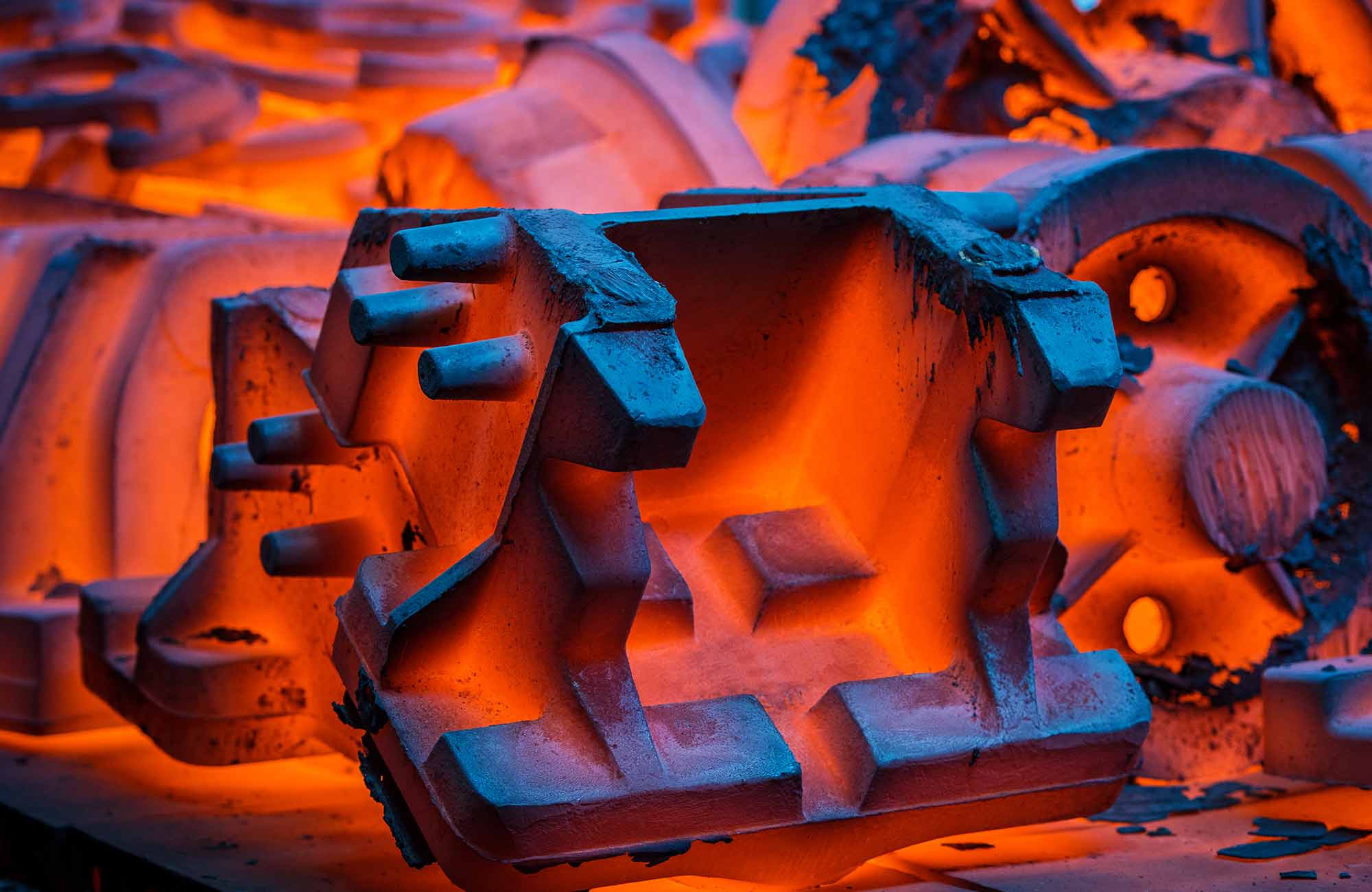
Sand casting can be performed using several different molding methods. The right method depends on factors such as part size, geometry, production volume, dimensional requirements, and the material being cast.
Green sand casting uses a mixture of sand, clay, water, and other additives to create the mold. The term “green” refers to the fact that the mold is used in a moist, uncured condition. Green sand is widely used because it is economical, versatile, and well suited for a broad range of casting sizes and production volumes.
No-bake sand casting uses chemically bonded sand that cures at room temperature rather than relying on moisture and mechanical compaction. This process can produce larger molds and more complex geometries while providing good dimensional control. No-bake molding is commonly used for large industrial components and lower-volume production.
Shell molding uses resin-coated sand that is heated against a pattern to form a thin, rigid shell. The resulting mold provides better dimensional accuracy and surface finish than conventional green sand molding. Shell molding is generally used for smaller to medium-sized components where tighter tolerances and a smoother surface are important.
3D-printed sand casting uses additive manufacturing to produce molds and cores directly from a digital model. This eliminates the need for conventional patterns and can be useful for highly complex geometries, prototypes, and low-volume production. It also allows internal passages and other features that may be difficult to produce using traditional tooling.
Each sand casting method offers different advantages in terms of tooling cost, production volume, part size, complexity, surface finish, and dimensional accuracy. The appropriate process depends on the specific requirements of the casting and the overall production objectives.
The versatility of sand casting allows a wide range of ferrous and non-ferrous metals to be cast, from aluminum and magnesium to carbon steel, stainless steel, cast iron, and copper alloys. Material selection depends on the part’s mechanical requirements, operating environment, size, geometry, and intended application. Common materials and grades used in sand casting include:
Material | Common Alloys / Grades | Typical Applications |
Alloy Steel | 4140, 4340, 8620 | Heavy-duty and wear-resistant components |
Aluminum | A356, A319, A380 | Housings, brackets, machinery components |
Carbon Steel | ASTM A27 60-30, 65-35, 70-36; ASTM A216 WCA, WCB, WCC | Structural and industrial components |
Cast Iron | Gray iron, ductile iron | Engine components, pump bodies, industrial equipment |
Copper & Copper Alloys | Brass, bronze, copper | Valves, fittings, bushings, electrical and industrial components |
Magnesium | AZ91 and other magnesium alloys | Lightweight housings and structural components |
Stainless Steel | 304, 316, duplex grades | Corrosion-resistant industrial components |

Sand casting stands out as one of the most widely used casting techniques in the manufacturing world. However, like any manufacturing method, sand molding has advantages and limitations that are important to understand when determining if it’s the right method for your custom parts.
Sand casting is ideal for low- to medium-volume production runs, prototype castings, and the conversion of welded components to castings. Sand casting is a highly sustainable manufacturing process, even though each mold is used only once.
The main advantages of sand casting include:
One of the most attractive features of sand casting is the low initial setup cost. It’s also easier and less expensive to modify sand casting molds if your design changes.
While offering significant benefits like flexibility and cost-effectiveness, sand casting is not a viable option for all applications. Here are some of the major drawbacks to sand casting:
When the disadvantages of sand casting are properly understood, manufacturers can overcome them. By making production decisions that mitigate these issues, sand casting companies can help clients enjoy the benefits of sand casting.

Sand casting is used across a wide range of industries because it can produce components in many sizes, geometries, and metal alloys. Common applications include:
Innovations in sand casting have enabled more complex designs with faster lead times. New binders, better recycling processes, and improved mold pattern technologies have improved the sand casting process while lowering costs and increasing sustainability.
Advances in sand casting have significantly transformed the sand casting process, improving the efficiency of manufacturing and the quality of components. Key innovations include everything from automation of mold handling and pouring and 3D printing to solidification modeling and non-destructive testing (NDT).
Modern innovations in sand casting have also improved sustainability by reducing waste and energy consumption. By recycling sand and using sustainable binders, sand casting manufacturers comply with regulations and appeal to environmentally conscious consumers.
Good casting design can improve part quality, reduce defects, and minimize manufacturing costs. Key considerations include wall thickness, draft angles, fillets and radii, parting lines, cores, machining allowances, and casting tolerances. Designing these features appropriately helps ensure the part can be molded, cast, and finished efficiently.
For more detailed recommendations, see our Sand Casting Design Guide.
Sand casting defects can result from issues with mold preparation, metal chemistry, pouring conditions, solidification, or part design. Proper process control and inspection are important for identifying and preventing defects before castings reach the machining or assembly stage.
Common sand casting defects include:
The appropriate prevention method depends on the type and cause of the defect. For a more detailed overview of casting defects, including their causes and prevention methods, see our Metal Casting Defects guide.
Sand casting is one of several methods used to produce metal components. The right process depends on factors such as part size, geometry, material, production volume, dimensional requirements, surface finish, and tooling cost.
Sand casting can produce components ranging from relatively small parts to very large castings. The practical size limit depends on the foundry’s molding, handling, and melting equipment as well as the part’s design and material.
Sand casting generally has relatively low tooling costs compared with processes that require permanent metal molds. Total part cost depends on factors such as material, casting size and weight, production volume, pattern requirements, machining, finishing, and inspection.
Yes. Sand castings are often CNC machined after casting to achieve tighter dimensional tolerances or create finished features such as holes, threads, and precision mating surfaces.
Yes. Cores can be used to create internal passages, cavities, and other features that cannot be formed by the pattern alone. The complexity of the casting depends on the molding method, part design, and core requirements.
Production time varies based on the part, material, tooling requirements, quantity, and finishing requirements. Simple castings may have relatively short production cycles, while complex components requiring patterns, cores, machining, and inspection can take longer.
Yes. Sand casting can be practical for prototypes and low-volume production because patterns and molds can generally be produced at a lower initial cost than permanent tooling.
When selecting a casting method, factors like budget, production volume, and part complexity are crucial in determining the best manufacturing process for your project. TFG specializes in a variety of metal manufacturing solutions and provides assistance with material selection and design optimization.
Contact us today to learn more about sand casting options for your manufacturing needs.

