Standard investment casting works well for common alloys, but introducing highly reactive metals or intricate geometries requires specific environmental controls to maintain structural integrity. Vacuum investment casting solves this by removing atmospheric gases from the melting and pouring environments.
By applying negative pressure during the pour, this specialized metallurgical process prevents oxidation and reduces the internal voids that compromise part density. Understanding the physics of this controlled environment reveals exactly why certain high-performance components require vacuum assistance to achieve structural integrity.
Table of Contents
What Is Vacuum Investment Casting?
Vacuum investment casting is an advanced metal casting process that melts and pours metal alloys inside a controlled vacuum environment. This technique modifies traditional lost-wax casting by removing atmospheric gases from the chamber before the pour. The vacuum prevents oxygen from reacting with the molten metal and removes the trapped air that causes internal porosity.
Key Takeaways
- Vacuum investment casting relies on a controlled vacuum environment to prevent oxygen from reacting with molten metal alloys.
- The process removes the trapped gases that cause porosity and structural weakness in traditional lost-wax casting.
- Negative pressure actively pulls molten metal into intricate mold features to create precise thin-walled components.
- This method is ideal for casting reactive metals like titanium or nickel-based superalloys without contamination.
Standard Investment Casting vs. Vacuum-Assisted Investment Casting
Procurement leads must evaluate the specific metallurgical needs of their components when choosing a casting method. The gravity-poured-in-air method works well for standard alloys and simple shapes, but high-performance parts require specific environmental controls to maintain strict tolerances. Comparing traditional investment casting against vacuum-assist mold pouring reveals clear differences in how each process handles fluid dynamics and defect prevention.
Transitioning a complex gravity-poured component to a vacuum environment often stabilizes the production run. When a complex design requires precise fills in intricate cavities, applying vacuum-assist mold pouring changes the fluid dynamics entirely. The negative pressure pulls the metal into the deepest cavities before it can cool, so the casting achieves full structural density without requiring a complete redesign of the part.
Process Variable | Traditional Investment Casting | Vacuum Investment Casting |
Atmospheric Conditions | The metal melts and pours in open air, exposing the molten alloy to oxygen and nitrogen. | The system seals the melting and pouring chambers under a strict vacuum to remove reactive gases. |
Fluid Dynamics | Gravity pushes the molten metal into the ceramic shell, limiting how far the material travels before solidifying. | Negative pressure actively draws the molten metal into the mold to fill extremely thin walls rapidly. |
Defect Mitigation | Trapped air can create voids and misruns, requiring operators to vent molds carefully. | The vacuum environment inherently removes the air that causes gas porosity to produce denser parts. |
Alloy Compatibility | This method handles standard materials like carbon steel effectively but is not suitable for highly reactive metals. | This approach accommodates reactive metals to prevent severe oxidation during the pour. |
Step-by-Step: The Vacuum Investment Casting Process
A successful investment casting vacuum run requires precise coordination of tooling and equipment. The process begins with an accurate wax pattern and ends with a solid metal component formed inside a hollow cavity.
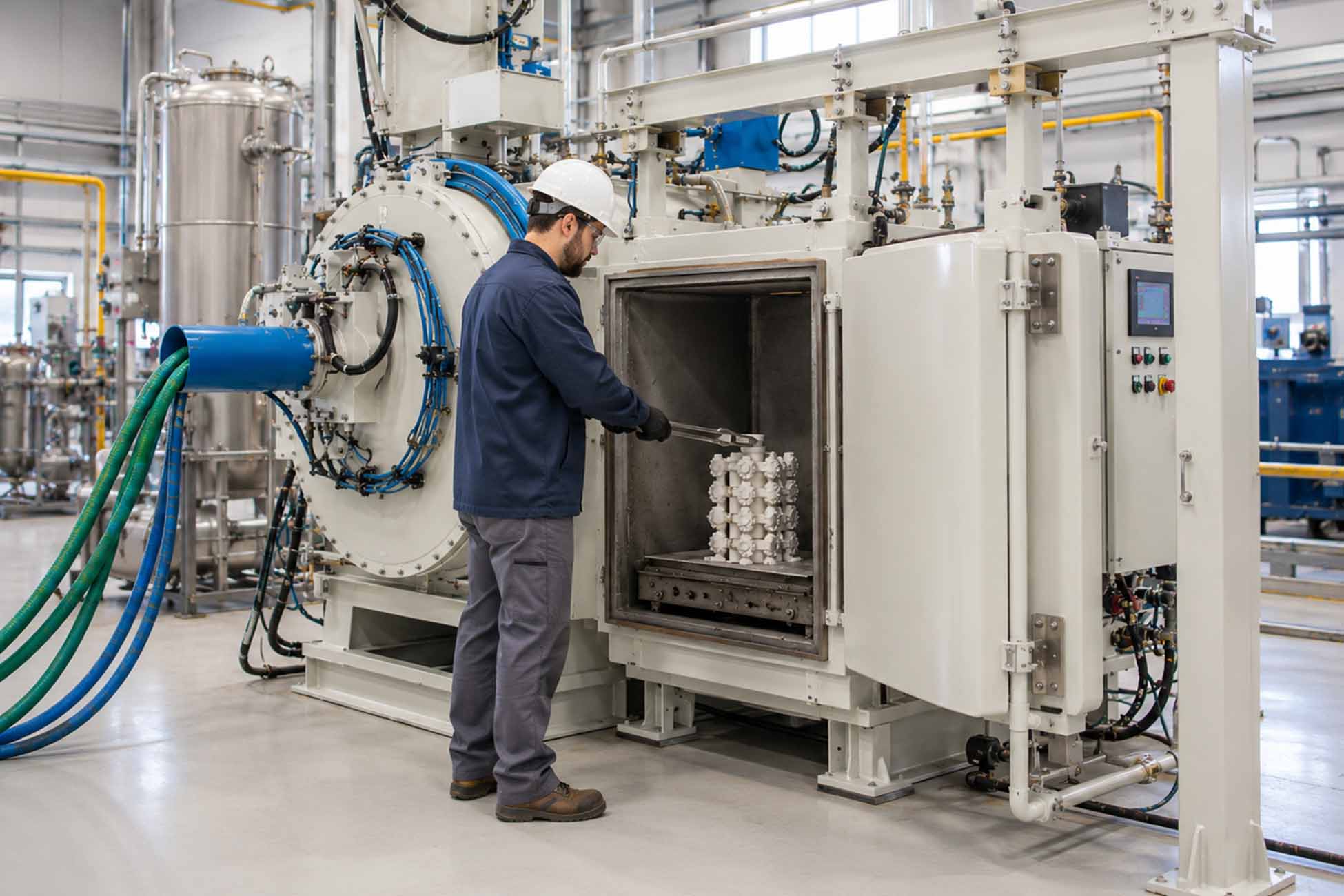
Visualizing the layout of a modern casting facility reveals a sequence that includes dedicated climate-controlled rooms for shell building and heavily monitored vacuum chambers where the actual pour takes place. The clear flow of molten metal through these sealed chambers ensures optimal density. Understanding this sequence of operations helps engineering teams align their designs with the physical realities of the casting floor.
Stage 1: Investing and Degassing the Ceramic Slurry
The first stage involves building the ceramic shell around a sacrificial wax pattern. Technicians dip the pattern into a liquid ceramic slurry and coat it with a fine sand known as stucco material. They repeat this process multiple times to build a shell thick enough to withstand the heat of molten metal.
Before the shell dries completely, the team places it in a specialized vacuum chamber for degassing. This critical step removes trapped gases and microscopic air bubbles from the wet slurry, so the inner surface of the mold cures exceptionally smooth. A smooth mold interior directly translates to a superior surface finish on the final cast part.
Stage 2: Melting and Vacuum-Assist Mold Pouring
Once the ceramic shell cures and operators melt out the wax, the actual casting phase begins. The team places the pre-heated mold into the pouring chamber and seals the system to draw a deep vacuum. Inside an induction furnace, the solid alloy melts rapidly while remaining completely isolated from atmospheric oxygen.
The physics of negative pressure then take over during the pour. The vacuum environment alters the surface tension of the molten metal, and this allows it to flow freely into the microscopic details of the mold without trapping air. This controlled environment ensures the metal solidifies uniformly to create a dense and structurally sound component.
Core Advantages
Engineers choose the vacuum casting process to solve specific metallurgical challenges that arise during standard gravity pouring. This method provides strict control over the casting environment, so foundries can repeatedly produce high-performance parts for the Medical, Energy, and Construction industries. Mapping common casting defects directly to their vacuum-driven solutions demonstrates why this process is essential for medium to large volume production runs.
Common Casting Defect | Vacuum-Driven Solution |
Air bubbles | The controlled vacuum environment removes atmospheric gases from the chamber to deliver defect-free structural integrity. |
Oxide layers | The complete absence of oxygen provides critical oxidation prevention to stop reactive metals from forming brittle crusts. |
Pitting and burrs | Degassing the ceramic shell creates a perfectly smooth mold cavity to drastically reduce surface imperfections. |
Cold-type defects | Negative pressure actively pulls metal into thin sections before it cools to improve the overall yield rate for complex parts. |
Preventing Gas Porosity for Structural Integrity
Trapped air is the primary cause of weakness in cast metal components. When metal pours into a standard mold, it can fold air into the liquid alloy to create microscopic voids known as gas porosity.
These internal air bubbles act as stress concentrators that lead to premature mechanical failure under heavy loads. Vacuum casting removes the reactive air from the pouring environment. The negative pressure environment ensures the molten alloy solidifies into a dense, uniform structure capable of withstanding extreme operational stress.
Achieving Superior Surface Finishes and Complex Geometries
Standard casting methods struggle to fill intricate mold details because the molten metal cools and thickens as it flows. Vacuum casting overcomes this limitation by using negative pressure to pull the metal rapidly into the deepest recesses of the mold.
This allows engineers to design complex geometries and exceptionally thin-walled components without worrying about incomplete fills. The degassed ceramic mold also prevents pitting and burrs on the exterior of the part. The resulting surface finish is remarkably smooth, so the component requires far less machining after it leaves the foundry floor.
Preventing Oxidation in Reactive Metal Alloys
Certain high-performance metals react violently when exposed to oxygen at melting temperatures. If these metals pour in open air, they form thick oxide layers that alter the mechanical properties of the final part. The vacuum environment provides critical oxidation prevention, making it the preferred method for casting these advanced materials.
Metal Alloy Category | Air-Melt Environment | Vacuum Environment |
Titanium | Highly reactive with oxygen and nitrogen, resulting in severe contamination and brittle parts. | Pours cleanly with complete oxidation prevention to retain its high strength-to-weight ratio. |
Nickel-based superalloys | Prone to developing oxide layers that compromise heat resistance and structural stability. | Pours flawlessly to maintain a pure crystalline structure for high-temperature applications. |
Standard stainless steel | Performs well as standard air melt alloys using traditional gravity methods. | Benefits from vacuum assistance only when the design features extremely intricate details. |
Industrial Applications
The reliability of vacuum-cast components makes them indispensable across heavy industry and healthcare. In the medical sector, manufacturers use this process to create intricate medical device housings and precision surgical tools from biocompatible titanium. The energy industry relies on vacuum casting to produce heat-resistant energy turbine components that must endure extreme temperatures without warping. For heavy construction and mining equipment, engineers specify this method to cast high-strength structural brackets that support massive dynamic loads.
Design for Manufacturing and Sourcing Quality Parts
Preparing complex metal parts for a vacuum casting run requires rigorous engineering oversight long before the metal melts. Achieving consistent quality at scale demands a structured Design for Manufacturing approach to ensure engineering feasibility and cost efficiency.
Engineering teams must follow a clear framework to transition a CAD file into a physical production run:
- Analyze geometry flow: Engineers evaluate wall thicknesses and transition points to ensure proper molten metal flow under negative pressure.
- Verify material specifications: Teams select the exact alloy required and secure material certifications to support strict metallurgical compliance.
- Establish strict tolerances: The design team defines required tolerances and maps out secondary operations to meet built-to-print specifications.
The Federal Group USA is a leading U.S.-owned manufacturing partner producing custom investment castings since 1980. We manage this entire process through a comprehensive 8-step client lifecycle, guiding clients from initial engineering feasibility reviews through full-scale production.
Using advanced vacuum-assist machinery and premium metal alloys, our on-the-ground teams enforce QMS 9001:2015 Certified standards at every phase of the production lifecycles. By coordinating the casting process, secondary operations, and global logistics, we secure your custom metal supply chain so you receive reliable components delivered on time.
Frequently Asked Questions
Does Vacuum Casting Eliminate the Need for Secondary Operations?
Vacuum casting improves surface finishes and dimensional accuracy, but it rarely eliminates secondary operations entirely. Most engineered components still require precision machining to hit exceptionally tight tolerances on mating surfaces. Processes like tapping threads or deburring edge gates remain necessary for final assembly. The casting process simply reduces the volume of material that needs to be removed, and this lowers overall machining costs. Your manufacturing partner will review the specifications to determine exactly which finishing steps are required.
What Is the Difference Between Single-Chamber and Dual-Chamber Melting?
Single-chamber melting houses both the furnace and the mold within the same sealed vacuum environment. This setup requires the system to break the vacuum and repressurize every time a new mold enters the chamber, which increases cycle times. Dual-chamber melting separates the melting furnace from the pouring zone using a specialized isolation valve. This allows operators to load new molds into the pouring chamber without breaking the vacuum in the melting chamber. High-volume production runs rely on dual-chamber systems to maintain continuous pouring and maximize efficiency.
How Does Vacuum Casting Reduce Overall Material Waste?
The process achieves a high degree of precision on the first pour, and this directly leads to a measurable reduction in scrap rates. Because negative pressure forces the metal into every crevice, foundries experience far fewer misruns and incomplete fills compared to gravity pouring. The exceptional surface finish also means less metal is cut away and discarded during secondary machining phases. This material waste reduction becomes highly critical when pouring expensive reactive alloys like titanium. Maximizing the yield rate per pour ultimately lowers the per-unit cost across the entire production run.
Sandor Holzer
Chief Operating Officer
As the COO of The Federal Group, Sandor manages operational excellence and strategic initiatives, leveraging his extensive experience in supply chain optimization and process improvement. With a relentless focus on efficiency and quality, he drives organizational growth and fosters a culture of innovation.
Up Next